B2B Demand Generation vs. Lead Generation for SaaS
b2b demand generationdemand generation vs lead generationB2B SaaS funnel
B2B Demand Generation vs. Lead Generation for SaaS
B2B demand generation builds awareness before a need exists; lead generation captures in-market buyers. See how the split changes SaaS attribution and budget.
Request a quote and our experts will contact you within 24 hours with tailored solutions and pricing.
B2B Demand Generation vs. Lead Generation for SaaS
By the Editorial Team | Published: November 4, 2026
B2B demand generation is the practice of building awareness and preference for a category and a vendor before a buyer identifies a need, while lead generation captures contact details from buyers who are already in-market. Most B2B SaaS teams cannot separate the two in their reporting. Branded search and demo forms then collect last-touch credit in the customer relationship management (CRM) system, and the upstream spend that created the demand gets cut. This guide defines both functions, shows the operational split, and sets out what each should be measured on. For the wider framework, see attribution models in B2B marketing.
Key Takeaways
B2B demand generation builds category awareness before a need exists; lead generation captures buyers who are already in-market.
Last-touch attribution gives branded search and demo forms credit for demand created upstream, which makes upstream spend look wasteful.
In the 2026 Benchmarkit survey, 55% of marketers would protect demand spend in a budget cut versus 11% for brand (Benchmarkit, 2026).
Marketing and sales need separate metrics: pipeline influenced and branded search trend for demand, marketing-qualified lead (MQL) to sales-qualified lead (SQL) conversion and cost per SQL for capture.
What Is B2B Demand Generation and How Does It Differ From Lead Generation?
B2B demand generation is the work of building category awareness and preference before buyers identify a need, while lead generation captures contact details from buyers already in-market. Most teams cannot split the two in reporting: only 39% of companies know how much marketing spend targets in-market buyers (Benchmarkit, 2026). Each function needs its own goal, metric and budget line.
Two marketers at a glass wall sketching two separate stages of a B2B funnel with markers
Demand generation works on the buyer's mind. Lead generation works on the buyer's calendar. A buyer who has never heard of a vendor will not request a demo, so capture spend can only harvest what creation spend planted.
Is lead generation part of demand generation, or a separate function?
Sources disagree. Some treat lead generation as a subset of demand generation, and others run the two as separate functions. For a revenue operations team the label matters less than the setup: each function needs its own goal, its own metric and its own line in the budget, so that neither hides inside the other's numbers.
Why Does Demand Creation Have to Happen Before Lead Capture?
Demand creation has to come first because B2B SaaS buyers choose their shortlist before they contact any vendor. The 6sense 2025 Buyer Experience Report found buyers purchase from their Day One shortlist 95% of the time, up from 85% (6sense, 2025). A lead capture program can only reach buyers whose preferences are already set.
A software buyer typing a question into an AI chatbot on a laptop at a kitchen table
The same 6sense report found 94% of buying groups rank vendors before contacting sellers (6sense, 2025). The dark funnel is the buyer research that happens before any form fill and leaves no tracked click. AI chatbots have made it larger. G2 describes the shift directly: "The discovery phase has compressed from hours of website browsing and report reviewing to a single prompt in an AI chatbot." (G2, 2026)
What the G2 buyer data shows
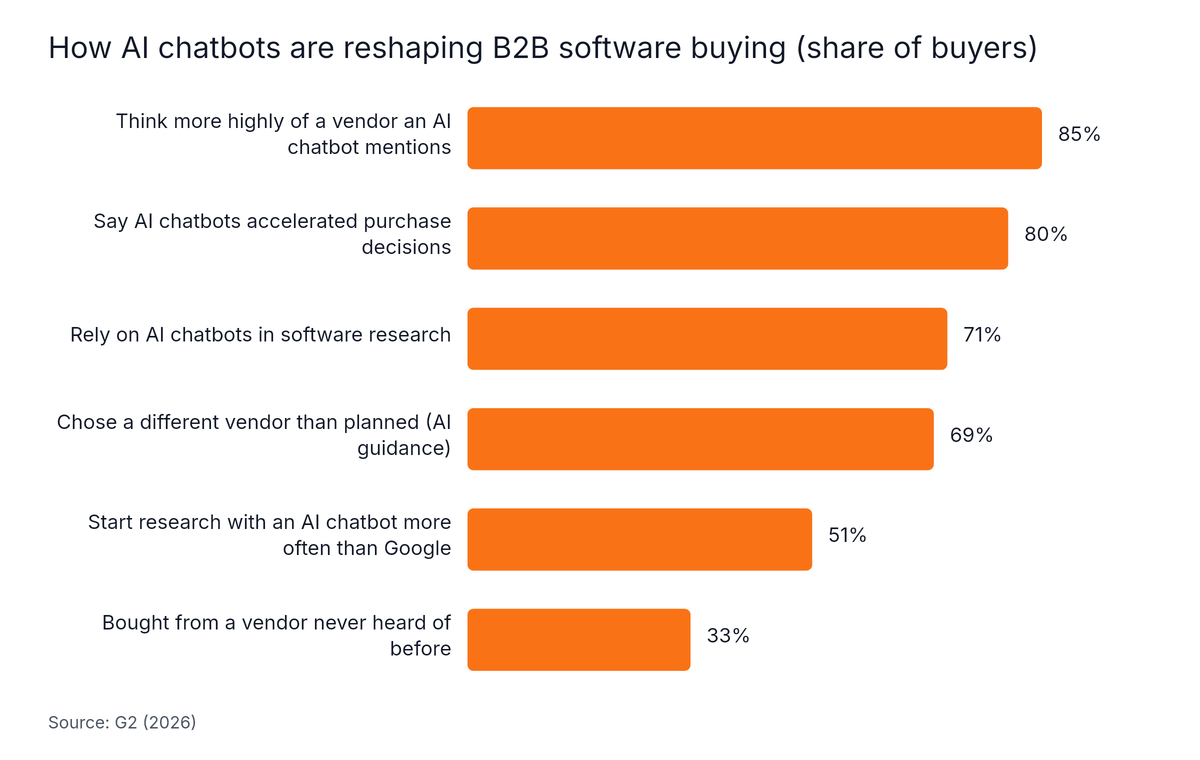
A G2 survey of 1,000+ software buyers, published in April 2026, found 51% start research with an AI chatbot more often than with Google (G2, 2026). It also found 71% rely on chatbots at some point in software research, up from 60% about seven months earlier, and 69% chose a different vendor than initially planned based on chatbot guidance. Another 33% bought from a vendor they had never heard of before (G2, 2026). In the same G2 data, 85% think more highly of a vendor an AI chatbot mentions and 80% say chatbots accelerated purchase decisions.
Horizontal Bar chart: How AI chatbots are reshaping B2B software buying (share of buyers). Highest: Think more highly of a vendor an AI chatbot mentions at 85%.
Shortlists still hold. Buyers who sourced recommendations from AI chatbots were more likely to buy from their initial shortlist than those who did not, 80% versus 65% (G2 2026 Buyer Behavior Report, 2026). G2's summary is short: "In the answer economy, trust is the new currency." (G2, 2026)
For a B2B SaaS team, this means "capture" can happen inside a chatbot the vendor cannot see. A lead form is often the last visible step of a decision made earlier.
Why Does Branded Search Get Credit for Pipeline That Demand Generation Created?
Branded search gets credit for pipeline that B2B demand generation created because last-touch attribution gives all value to the final tracked click, and buyers who already know a vendor often search its name last. Only 39% of companies know how much spend targets in-market buyers (Benchmarkit, 2026), so the misallocation often goes unseen.
An operations manager comparing printed CRM source reports at a desk, circling the branded search line
Last-touch attribution is a model that assigns 100% of a conversion to the final touchpoint. Branded search is search traffic where the query includes the vendor's own name. The result is a predictable budget error. Branded search, direct traffic and the demo form collect credit, while the podcast, community presence or content that made the buyer search the brand shows nothing. The page on last-touch attribution and where it breaks down covers the mechanics in detail.
Tracking gaps make the bias worse
Audit data: In a June 2026 study published by GrowthSpree covering 104 Google Ads accounts and $78.0M in spend, 91% had no Google click ID (GCLID) reaching the CRM and 89% ran default attribution. After a 90-day attribution fix, the share of closed-won deals traced to a campaign went from 0% to 67% (GrowthSpree, June 2026).
Without a stored click ID, the CRM cannot link a deal to its source, so most pipeline falls into "direct" or "unknown". Google Ads now uses data-driven attribution by default, and other models are no longer supported in the platform.
Reconcile system-attributed and self-reported pipeline
Self-reported attribution is a "how did you hear about us" field on a form, read next to the tracked source in the CRM. Reporting both side by side shows how much credit branded search absorbed, and it keeps system-attributed and self-reported pipeline visible as separate numbers. For model selection, see marketing attribution models for a long B2B sales cycle.
How Do You Measure Demand Generation, and Which Metrics Should Marketing and Sales Own?
B2B demand generation is measured with signals that sit before the form, such as branded search trend, self-reported source and pipeline influenced, while lead generation is judged on MQL to SQL conversion and cost per SQL. MQL volume alone misleads: 78% of form fills in 104 audited Google Ads accounts never became a sales-qualified lead (GrowthSpree, June 2026).
A marketing lead and a sales lead at a table agreeing on metric ownership using index cards
A sales-qualified lead (SQL) is a lead that sales has accepted against written criteria. Pipeline influenced is the value of deals where a buyer touched a creation channel at any point before closing, which is broader than pipeline sourced by a first touch. The 2026 B2BMX survey from Demand Gen Report says pipeline influenced is replacing MQLs as a headline metric (Demand Gen Report, 2026).
Metric
Function
What it shows
Caution
Branded search trend
Demand generation
Whether awareness is growing
Also rises with sales activity
Pipeline influenced
Demand generation
Deals touched by creation channels
Not the same as pipeline sourced
MQL to SQL rate
Lead generation
Quality of captured leads
26% paid search, 30% LinkedIn, 51% SEO (First Page Sage, 50+ clients, updated June 2025); a separate 13% to 18% median for B2B SaaS Google Ads (GrowthSpree, April 2026). Stage definitions differ, so do not average them
Cost per SQL
Lead generation
Efficiency of capture
Tracked pipeline at a 0.71 correlation across 1,412 ad variants; click-through rate at 0.09 (GrowthSpree, June 2026)
Closed-won traced to a campaign
Both
Health of tracking
0% to 67% after a 90-day attribution fix (GrowthSpree, June 2026)
What Happens to Pipeline If You Cut Demand Creation Spend?
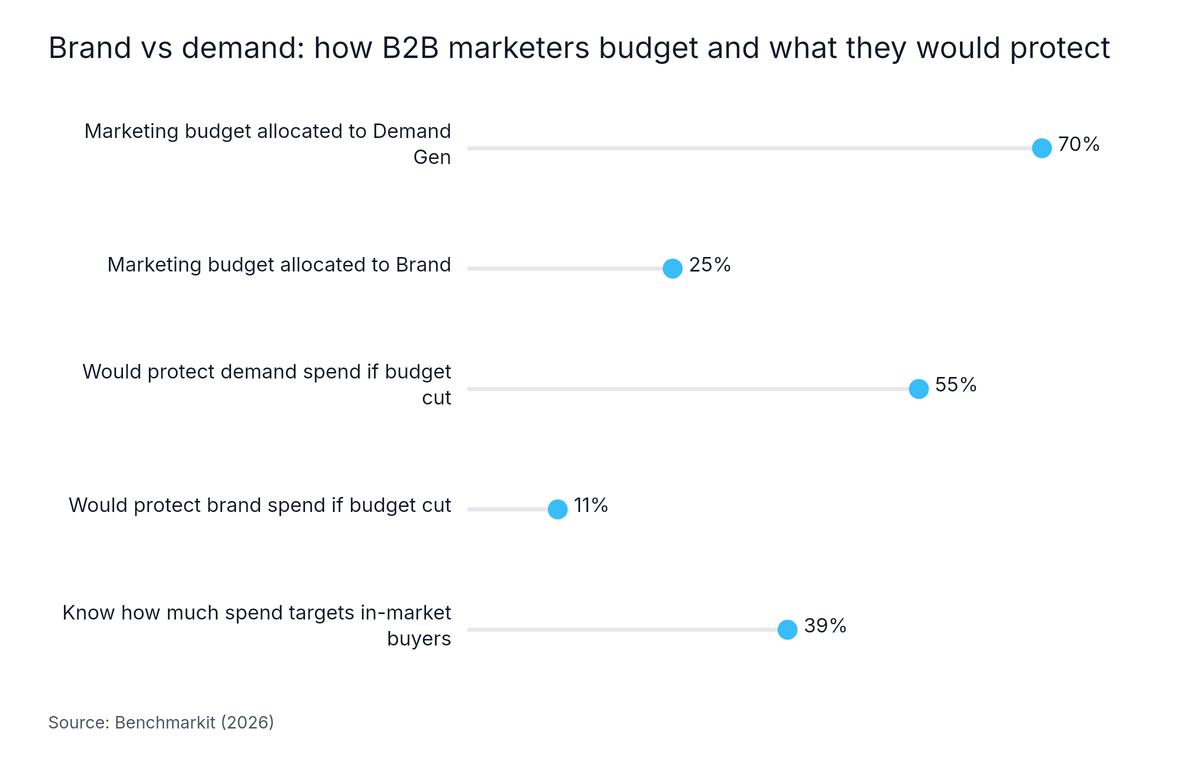
Cutting B2B demand generation spend removes the upstream activity that fills the shortlist, but the damage appears late and under another label. In a 2026 Benchmarkit survey, only 39% of companies knew how much marketing spend targets in-market buyers (Benchmarkit, 2026), and 55% would protect demand spend in a cut versus 11% for brand.
Lollipop chart: Brand vs demand: how B2B marketers budget and what they would protect. Highest: Marketing budget allocated to Demand Gen at 70%.
The Benchmarkit survey also shows how budgets are split. Its "demand gen" label includes in-market capture spend, so read these as a mix of both functions:
Measure
Figure (Benchmarkit, 2026)
How to read it
Median marketing budget to demand gen
70%
Includes in-market capture spend
Median marketing budget to brand
25%
Closest proxy for pure creation
Would protect demand spend in a cut
55%
Capture spend that last-touch reports credit
Would protect brand spend in a cut
11%
Creation spend is cut first
Report demand gen efficiency as a top brand result
73%
Self-reported perception, not causal
Each figure comes from the same survey (Benchmarkit, 2026). The 73% is a perception, but it supports treating the two functions as linked. Three checks help defend upstream spend before cutting it:
Track the branded search trend line against creation activity.
Run a holdout test on one segment or region.
Compare win rate by exposure to creation channels.
Timing makes the error hard to see. The median sales cycle across 104 audited accounts was 84 days (GrowthSpree, June 2026), so a cut today shows up in pipeline about a quarter later. By then the cause is hard to trace.
When Is This Distinction Not Worth Making?
The split between B2B demand generation and lead generation matters least for teams with no sales team and no CRM, and for very early companies selling to a handful of known accounts. The framework also rests on contested terminology and survey data with stated limits, such as the Benchmarkit 70% demand gen budget share, which includes in-market capture spend (Benchmarkit, 2026).
Honest limits to keep in view:
Terminology is contested. Some sources call lead generation a subset of demand generation. Others run them as separate functions.
Survey data has caveats. The G2 and Benchmarkit figures are survey results, and the Benchmarkit 73% is a self-reported perception.
Buyers verify AI answers. TrustRadius's 2026 report found 63% of buyers used AI during purchase, and 94% of those fact-check AI answers at least some of the time (TrustRadius via MarketScale, 2026), so chatbot visibility alone does not win deals.
Tooling comes first. Without click IDs stored in the CRM, no model can separate creation from capture.
Frequently Asked Questions
Is lead generation part of demand generation, or a separate function?
Lead generation is treated as a subset of demand generation by some sources and as a separate function by others. What matters operationally is that each has its own goal and metric: B2B demand generation builds awareness and preference, while lead generation captures contact details from buyers who are already in-market.
How do you measure B2B demand generation if it does not produce form fills?
B2B demand generation is measured through signals that sit before the form, such as branded search trend, self-reported source answers, pipeline influenced and win rate by exposure. Form fills and MQL counts describe capture, not creation. Reporting system-attributed pipeline and self-reported pipeline side by side shows how much demand was built upstream.
What is self-reported attribution?
Self-reported attribution is a free-text "how did you hear about us" field on a demo or contact form, read alongside the tracked source in the CRM. It captures influences that leave no click, such as podcasts, peer recommendations and AI chatbot answers, and it exposes credit that branded search or direct traffic absorbed.
How does AI search change B2B demand generation?
AI search moves part of B2B buyer research into chatbots that vendors cannot track. TrustRadius's 2026 B2B Buying Disconnect Report found 63% of buyers used AI during purchase and 94% of those fact-check AI answers at least some of the time. Content that chatbots can cite now shapes demand before any form is filled.
What Should a B2B SaaS Team Do Next?
A B2B SaaS team should treat B2B demand generation and lead generation as two jobs with separate goals, metrics and budgets, then report both in one shared funnel view. The reason is shortlists: buyers purchase from their Day One shortlist 95% of the time (6sense, 2025), so capture metrics alone cannot show whether creation spend is working.
Start with four actions:
Define both functions in writing, with separate goals and budgets.
Store the click ID with every lead and send qualified stages back to the ad platforms.
Add a self-reported source field and report it next to the CRM source.
Test upstream spend with a holdout before cutting it, and judge capture on cost per SQL, not form fills.
Attribution fixes pay off: after a 90-day fix, the share of closed-won deals traced to a campaign went from 0% to 67% (GrowthSpree, June 2026). Software choices come later, and the marketing attribution software evaluation guide covers what to check before buying. To pressure-test a funnel, CRM or reporting question against the split described here, Meet with an expert for a free consultation.
Written by
Ishan Manchanda
Ishan Manchanda is co-founder of GrowthSpree, a B2B SaaS marketing consultancy founded in 2017 that has managed $60M+ in ad spend across 300+ B2B SaaS companies. He focuses on demand generation, go-to-market strategy and pipeline growth, and has been featured in Silicon Valley Times, SaaS Mag and the Unbounce podcast.
 Ishan ManchandaNov 13, 2026