Blog
Conversion Path: What It Is and How to Track One Across a Long B2B Sales Cycle
A conversion path is the sequence of touches before a deal converts. See where click IDs expire and how to track a B2B SaaS path across a widely cited 84-day cycle.
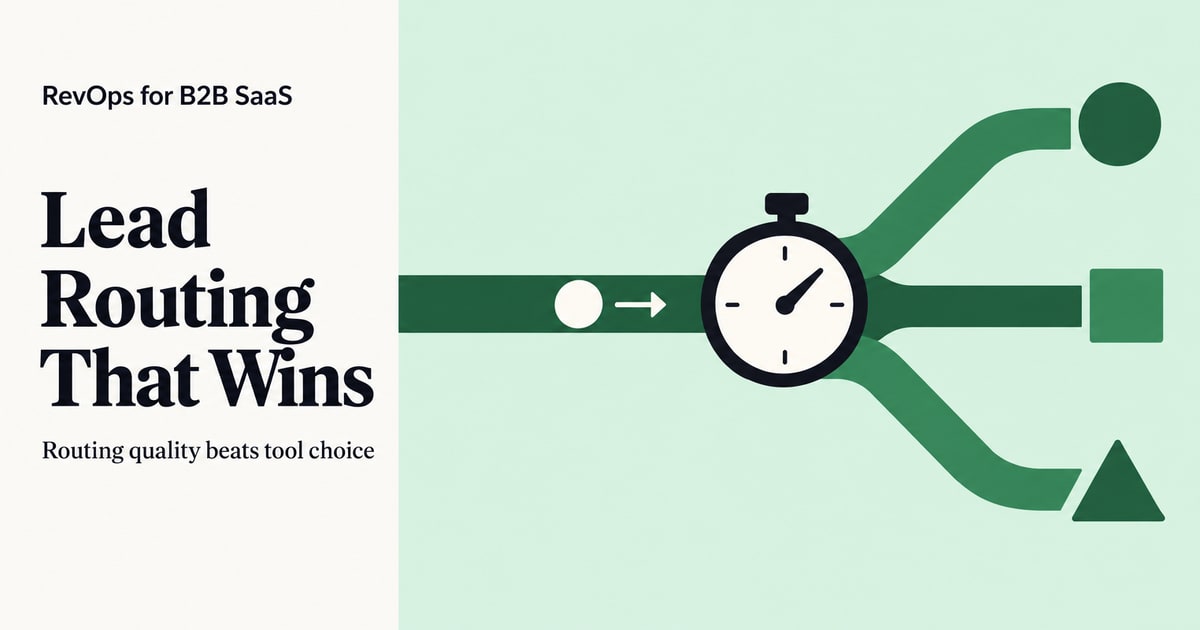
How to choose inbound lead routing software for B2B SaaS: what it must do, Series A checks, a 20 to 30 request test plan and MQL-to-SQL benchmarks.
 Ishan ManchandaNov 11, 2026
A conversion path is the sequence of touches before a deal converts. See where click IDs expire and how to track a B2B SaaS path across a widely cited 84-day cycle.
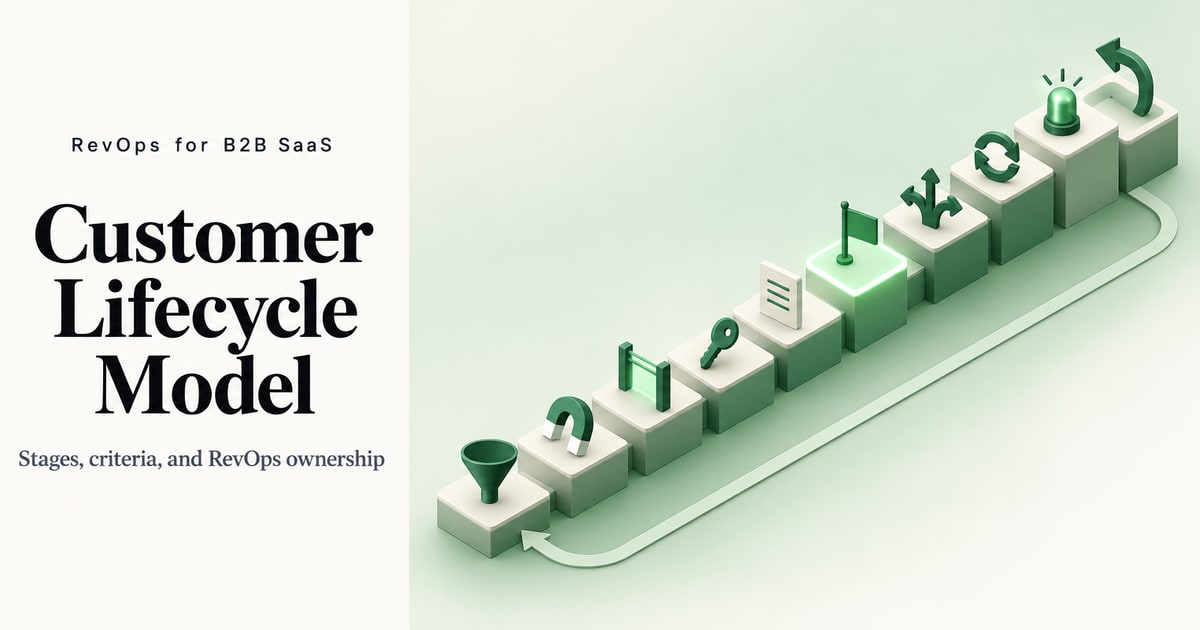
A customer lifecycle model for B2B SaaS: ten stages with entry criteria, triggers, CRM fields and owners, plus how RevOps keeps one number across teams.
ROAS definition, how ROAS differs from ROI, and why platform ROAS rarely matches closed-won revenue in B2B SaaS paid search, with a metric-by-audience guide.
Request a quote and our experts will contact you within 24 hours with tailored solutions and pricing.
Last updated: Nov 11, 2026
By the RevOps for B2B SaaS Editorial Team.
Inbound lead routing software is the system that assigns each new demo request or form fill to the right sales rep, applies matching and availability rules, and starts a response timer so the lead gets a reply quickly. Finding the best inbound lead routing software for B2B SaaS starts with the failure it has to prevent. In a 2026 mystery-shop of demo requests at 114 B2B companies, only one sent a personalized email within five minutes (Workato, 2026). A paid lead that waits in a shared inbox over a weekend is money already spent. This guide, from an independent revenue operations (RevOps) publication, covers what the software must do, what to check at Series A, and how to test any tool on your own data. For the wider category view, see lead routing software for B2B SaaS.
Key Takeaways
- No single inbound lead routing software is best for every B2B SaaS team: CRM, rep count and routing logic decide the fit.
- Routing logic should run in a fixed order: lead-to-account match, territory, round robin among available reps, then a fallback queue.
- A pre-purchase test of 20 to 30 demo requests per tool shows how a candidate really behaves.
- A 13% MQL-to-SQL rate sits inside published B2B SaaS ranges, but stage definitions change the benchmark.
No single product is the best inbound lead routing software for B2B SaaS, because the right choice depends on your customer relationship management (CRM) platform, rep count and routing logic. In a 2026 Workato demo-request test, companies with a routing tool replied in 3 hours 32 minutes versus nearly 13 hours without one (Workato, 2026), a correlation, not a controlled result.

The test is vendor-run and does not control for other differences between companies. A tool helps. It does not fix bad rules. RevOps for B2B SaaS does not rank or recommend vendors, so the table below sorts situations by category, based on practitioner guidance.
| Situation | Typical category | What to verify |
|---|---|---|
| Small team, HubSpot as the CRM | Native CRM workflows | Availability-aware assignment, out-of-office handling |
| Complex territories, Salesforce as the CRM | Native assignment rules or a dedicated routing tool | Account matching, reassignment rate |
| Demo form with high drop-off | Instant scheduling after form fill | Form-to-meeting handoff, calendar sync |
HubSpot and Salesforce appear here as category examples only. Check each vendor's own documentation, with the date you read it, before relying on any feature.
What we found: In a June 2026 audit of 104 Google Ads accounts ($78.0M in spend), 78% of form fills never became a sales-qualified lead (SQL) (GrowthSpree, June 2026). Routing cannot rescue a lead that was never qualified, so check the form and the stage definitions first.
Inbound lead routing software must assign an owner in seconds, match the lead to an existing account first, respect rep availability, and escalate to a fallback queue when nobody responds. Speed is the stake: in a 114-company demo-request test, none called within 5 minutes and only 42% called within the hour (Workato, 2026).
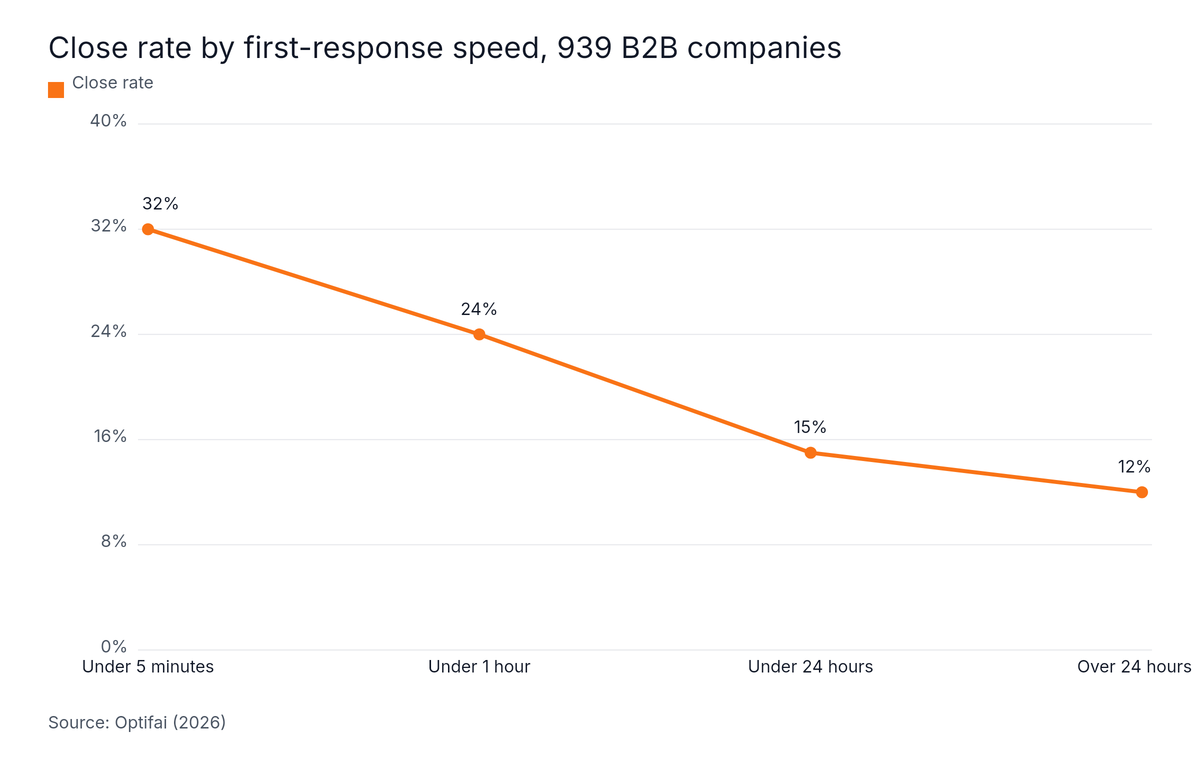
Source: Optifai, 2026
Speed to lead is the time between a lead's form submission and the first sales contact. Workato found average replies of 11 hours 54 minutes by personalized email and 14 hours 29 minutes by phone. In the publisher's words, "More than 99% of companies aren’t responding within 5 minutes." (Workato, 2026)
A separate benchmark of 939 B2B companies tracked close rate by first-response speed: 32% for responses under 5 minutes, 24% under 1 hour, 15% under 24 hours and 12% after 24 hours (Optifai, 2026). It is a vendor benchmark, and the link is correlational, not causal.
Out-of-office handling should remove an absent rep from the rotation before assignment, not reassign the lead after it has waited. A fallback queue is a shared pool that catches any lead left unclaimed when the SLA timer expires, and it should alert a named owner. As the editorial team's rule of thumb, route to the account owner's backup first, then to the queue, and review reassignment rate weekly.
In an analysis of nearly 4 million form submissions, immediate booking after form fill moved form-to-meeting conversion from 30% to 66.7% on average (Chili Piper, 2025). Chili Piper sells scheduling, so read the direction and discount the size. The same vendor reports that removing a second form lifted conversion by 50%, with no sample stated for that claim.
Inbound lead routing quality matters more than the choice of routing software, because the software only executes the rules it is given. Practitioner guidance orders the logic as lead-to-account matching, then territory, then round robin among available reps, then a fallback queue. As of 2026, only 1 of 114 tested companies sent a personalized email within 5 minutes (Workato, 2026).
Build the rules in this order:
Buyers raise this bar. A Gartner survey of 646 buyers found 67% prefer a rep-free experience (Digital Commerce 360, 2026). As Gartner's Alyssa Cruz put it, "B2B buyers are progressing through critical buying tasks in more autonomous ways" (Digital Commerce 360, 2026). A buyer who raises a hand has done the research already. Larger accounts need routing that handles buying groups too, since Forrester reports procurement as a decision-maker in 53% of buying cycles (Forrester, 2026).
No credible survey shows which lead routing software Series A B2B SaaS companies use, and that gap is itself the finding. The editorial team's rule of thumb sorts the choice by rep count: about 1 to 10 reps run simple rules and round robin, while 11 to 50 add territory logic and SLAs. Forrester finds procurement in 53% of buying cycles (Forrester, 2026).

| Team size | Routing need | Typical setup category | Check before buying |
|---|---|---|---|
| About 1 to 10 reps | Simple rules, round robin | CRM-native workflows | Out-of-office handling, alerts |
| About 11 to 50 reps | Territory, account matching, SLAs | Native rules or dedicated routing | Reassignment rate, fallback queue |
| Multiple regions | Time-zone coverage, consent rules | Dedicated routing | Regional coverage, data handling |
The table is the editorial team's rule of thumb, not survey data.
Native routing in HubSpot or Salesforce can handle simple rules, such as assignment by region or round robin across a small team. A dedicated tool becomes worth testing when you need account matching before assignment, availability-aware rotation or SLA timers with escalation. Confirm each capability in the vendor's own documentation, with the date you read it. HubSpot and Salesforce are category examples, not recommendations.
A free expert call can help map these checks to a specific funnel: Meet with an expert.
Test lead routing software by sending 20 to 30 test demo requests through each candidate and recording time to owner assignment, time to first touch, duplicate-account handling, out-of-office handling and fallback-queue behavior. The baseline to beat is poor: only 1 of 114 companies sent a personalized email within 5 minutes (Workato, 2026). Run the plan on your own CRM data.
This is a practitioner test plan, not a vendor standard. Source data should survive routing too. An audit of 104 Google Ads accounts found 91% had no Google click ID (GCLID) reaching the CRM (GrowthSpree, June 2026). See how ad click tracking breaks for the fix, and track the results weekly in a shared RevOps dashboard.
A 13 percent MQL to SQL rate is within published ranges for B2B SaaS, but no single figure is normal. First Page Sage reports 13% for B2B SaaS in its industry report (First Page Sage, 2025), and The RevOps Report puts the median at 13 to 15% (The RevOps Report, 2026). First Page Sage shows 38% in a separate report, so stage definitions drive the gap.
A marketing-qualified lead (MQL) is a lead that meets a defined score or firmographic threshold. A sales-qualified lead (SQL) is a lead sales has accepted against written criteria. Stricter SQL definitions produce lower rates.
| Source | B2B SaaS MQL to SQL | Note |
|---|---|---|
| First Page Sage industry report (2025) | 13% | SQL means vetted, meeting booked |
| First Page Sage full-funnel report (2026) | 38% | Different stage definitions (First Page Sage, 2026) |
| The RevOps Report (2026) | 13 to 15% | No sample or method stated |
| GrowthSpree, April 2026 | 13 to 18% | Published range, Google Ads, no stated sample |
The RevOps Report also splits the median by deal size: 18 to 22% for self-serve under $10K ACV and 8 to 12% for enterprise above $50K. As its analyst writes, "The single biggest lever for improvement is definition alignment" (The RevOps Report, 2026). Baseline your own rate by source and cohort. For channel detail, see sales conversion rates in B2B SaaS.
The inbound lead routing software guide from RevOps for B2B SaaS is not for teams with no sales team and no CRM yet, and it does not rank vendors. Most speed-to-lead evidence is vendor-run, including the Workato test of 114 companies, a small convenience sample (Workato, 2026). Treat every benchmark as a range to compare against.
A 13 percent MQL to SQL rate sits inside published B2B SaaS ranges: First Page Sage reports 13% (2025) and The RevOps Report puts the median at 13 to 15% (2026). First Page Sage shows 38% in a separate report, so stage definitions decide the number. Baseline your own rate by source and cohort.
No credible survey shows which lead routing software Series A B2B SaaS companies use. The editorial team's rule of thumb is simple CRM-native rules and round robin for roughly 1 to 10 reps, and dedicated routing with territory logic and response SLAs for 11 to 50 reps. HubSpot and Salesforce workflows are category examples, not recommendations.
Inbound lead routing software that matches the lead to an existing account, assigns an available owner within seconds, and escalates to a fallback queue when nobody responds can do this. The tool matters less than those rules. Test candidates with 20 to 30 demo requests and measure time to first touch.
Replace single-touch reporting with a stated approach that combines multi-touch attribution, a self-reported 'how did you hear about us' field, and branded search lift tests. A published range with no stated method rates single models at 38 to 58% accuracy and hybrids at 82 to 92% (GrowthSpree, 2026). Read more on last-touch attribution and choosing an attribution model.
Choosing inbound lead routing software for B2B SaaS comes down to rules, speed and proof, not a brand name. The main points:
Next step: bring your funnel and CRM setup to a free call and agree on a test plan.
Written by
Ishan Manchanda
Ishan Manchanda is co-founder of GrowthSpree, a B2B SaaS marketing consultancy founded in 2017 that has managed $60M+ in ad spend across 300+ B2B SaaS companies. He focuses on demand generation, go-to-market strategy and pipeline growth, and has been featured in Silicon Valley Times, SaaS Mag and the Unbounce podcast.