Blog
Conversion Path: What It Is and How to Track One Across a Long B2B Sales Cycle
A conversion path is the sequence of touches before a deal converts. See where click IDs expire and how to track a B2B SaaS path across a widely cited 84-day cycle.
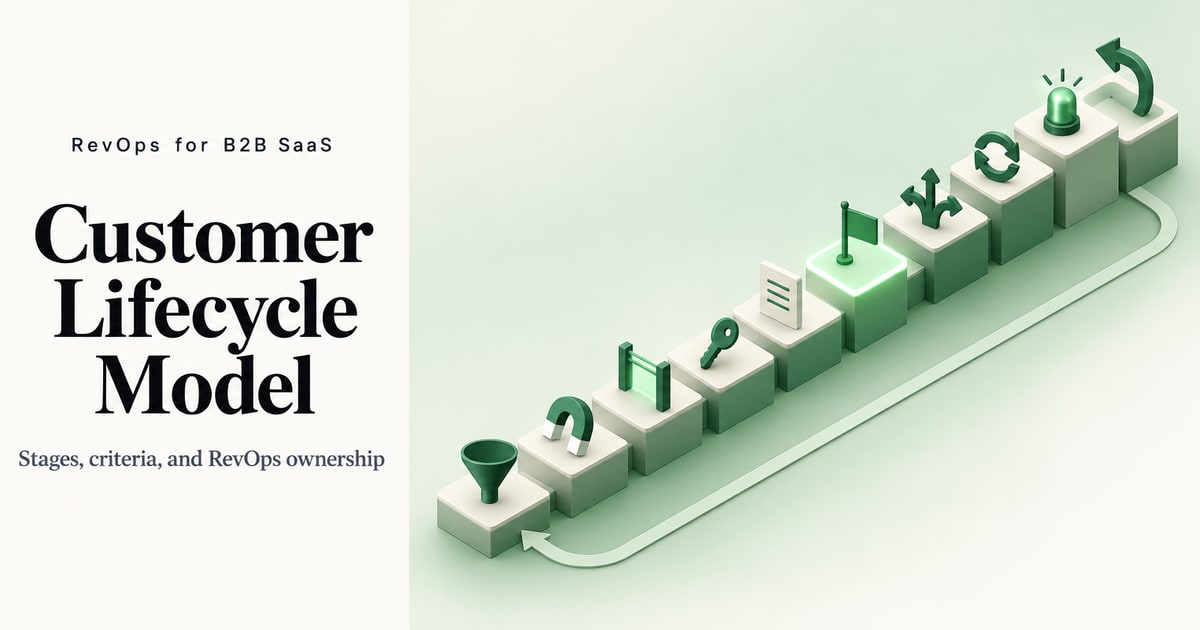
A customer lifecycle model for B2B SaaS: ten stages with entry criteria, triggers, CRM fields and owners, plus how RevOps keeps one number across teams.
 Ishan ManchandaNov 18, 2026
A conversion path is the sequence of touches before a deal converts. See where click IDs expire and how to track a B2B SaaS path across a widely cited 84-day cycle.
ROAS definition, how ROAS differs from ROI, and why platform ROAS rarely matches closed-won revenue in B2B SaaS paid search, with a metric-by-audience guide.
Incremental revenue is the closed-won revenue a campaign adds beyond baseline. Get the definition, formula and a step-by-step B2B SaaS example.
Request a quote and our experts will contact you within 24 hours with tailored solutions and pricing.
RevOps for B2B SaaS
Last updated: Nov 18, 2026
By the RevOps for B2B SaaS Editorial Team | Last updated: November 4, 2026
A customer lifecycle model is a written map of the stages a B2B SaaS account passes through, from first touch to renewal, with the specific buyer action that moves it from one stage to the next.
Most teams have the map and skip the actions. In 104 audited Google Ads accounts, 78% of form fills never became a sales-qualified lead (SQL), according to a GrowthSpree study from June 2026. That gap is a definition problem: marketing counts a form fill as a lead, and sales does not. This customer life cycle model guide sets out each lifecycle stage, the trigger that moves an account forward, and how revenue operations (RevOps) owns the definitions so both teams report one number. It also feeds the sales conversion rate benchmarks that depend on those stages.
Key Takeaways
- A customer lifecycle model for B2B SaaS is only useful when every lifecycle stage has a written entry criterion, a trigger event, a CRM field and an owner.
- Ten stages cover the full B2B SaaS funnel, from lead through renewal, at-risk or churned, and win-back.
- Expansion is a median 40% of net new ARR at B2B SaaS companies (Benchmarkit, 2026), so the model must continue past closed-won.
- Revenue operations should own stage definitions, because the same stage name produces different conversion rates until the definition is written down.
A customer life cycle model is the set of stages a B2B SaaS account moves through from first touch to renewal, with written entry criteria that decide when a record moves forward. Without criteria it is only a diagram, and the data under it is often weak: 76% of CRM users say less than half their CRM data is accurate and complete (Validity, 2025).
Two terms carry the whole model. Lifecycle stage is a customer relationship management (CRM) field value that states where a person or account sits in the journey from first touch to renewal. Stage definitions are the written entry criteria, trigger events, owners and CRM fields that make each lifecycle stage mean the same thing in every report.
Openprise, a RevOps data-automation vendor, states the principle in one line: "Good data quality starts with a definition." (Openprise, 2026) A lifecycle model applies that idea to the funnel.
| Element | Diagram only | Working lifecycle model |
|---|---|---|
| Stage names | Listed on a slide | Stored as CRM field values |
| Entry criteria | Implied or left to judgment | Written, tied to a buyer action |
| Trigger event | Not stated | Named event that moves the record |
| Owner | "The team" | One named function per stage |
| Reporting | Each team builds its own | One report both teams use |
The difference shows up in the quarterly review. With a diagram only, marketing can report a large lead count while sales calls only a small share of those leads real, as in the 78% form-fill gap above. A working model makes both numbers come from the same stage definitions.
A B2B SaaS customer lifecycle usually runs through ten stages: lead, marketing-qualified lead (MQL), sales-accepted lead (SAL), sales-qualified lead (SQL), opportunity, customer, expansion, renewal, at-risk or churned, and win-back. Each stage needs a written entry criterion tied to a buyer action. The criteria in this template are working defaults, not benchmarks.
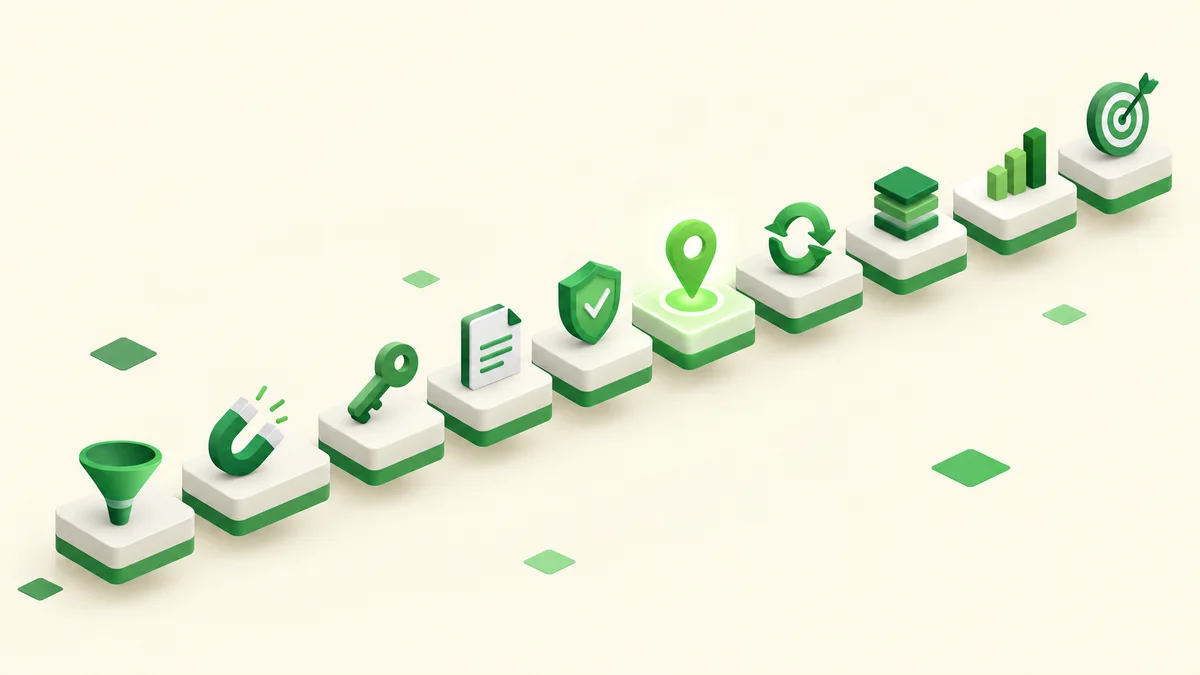
The table gives each stage an entry criterion, a trigger event, a CRM field and an owner. Adapt the thresholds to your own buying process before publishing them.
| Stage | Entry criterion | Trigger event | CRM field | Owner |
|---|---|---|---|---|
| Lead | A person is created with a valid business email | Form fill, sign-up or import | Lifecycle stage = Lead | Marketing ops |
| MQL | Meets the agreed score or firmographic threshold | Score crosses the threshold | Lifecycle stage = MQL, MQL date | Marketing ops |
| SAL | Sales accepts the MQL against written criteria | Rep accepts within the agreed window | Lead status = Working, SAL date | Sales development |
| SQL | Sales confirms a need, authority and a buying reason | Qualifying conversation held | Lifecycle stage = SQL, SQL date | Sales |
| Opportunity | A deal exists with an amount, close date and named buyer | Deal created after a qualified meeting | Deal stage on the deal object | Sales |
| Customer | A signed order form is recorded as closed-won | Closed-won, then kickoff held and first value event | Lifecycle stage = Customer (account) | Sales hands to customer success |
Stage names alone do not fix numbers. First Page Sage's B2B SaaS lead-to-opportunity benchmark is 6.2% (First Page Sage, 2025), while a published GrowthSpree benchmark from April 2026 gives a median MQL to SQL rate of 13% to 18% for B2B SaaS Google Ads. The two measure different stage pairs under separate definitions, so they should not be averaged.
The SAL stage is where marketing hands a record to sales, so it needs an acceptance window and a rejection reason. Lead routing rules decide who receives the record and how fast. The customer stage is the second handoff: name the event (signed order form, kickoff held, first value event) that moves ownership from sales to customer success.
Use as many stages as there are distinct buyer actions, handoffs and owners. A small team can merge SAL into MQL or SQL. A product-led motion adds a product-qualified lead stage ahead of the sales stages. A stage with no unique entry criterion or owner is a label, and it should be removed.
A lifecycle stage is a customer relationship management (CRM) field that records where a person or account sits in the journey, while a lead status records the working state of a record inside one stage. For revenue reporting, hold the stage at the account level and keep person-level fields for marketing follow-up.
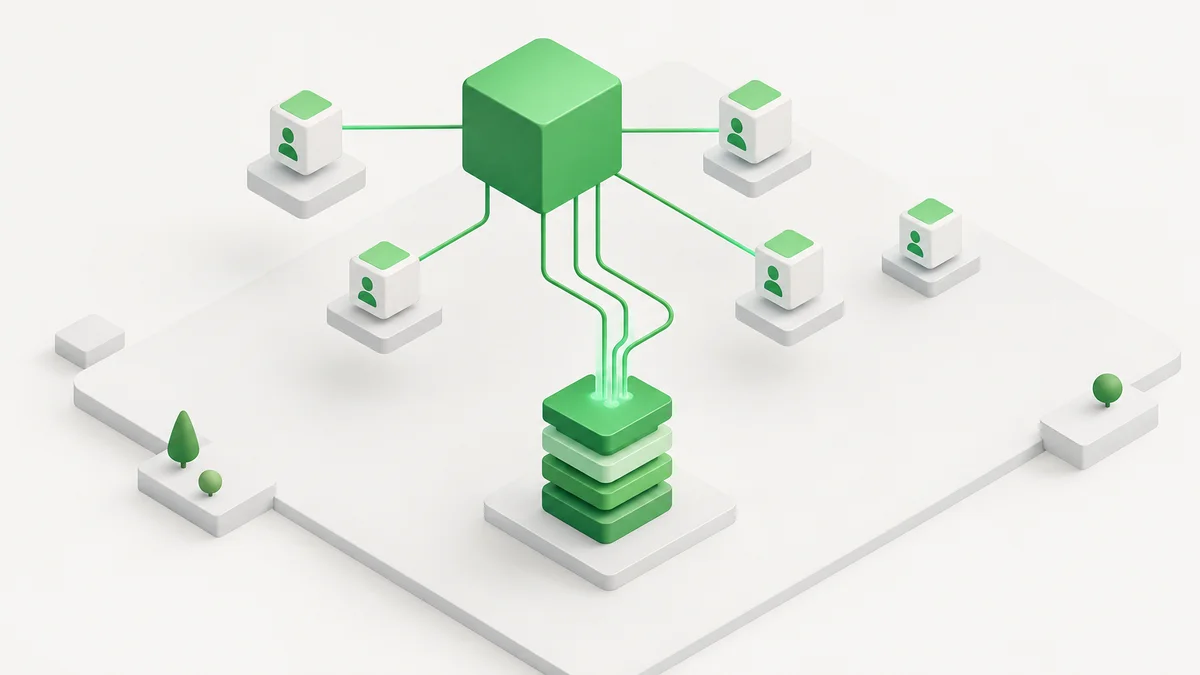
Lead status is a CRM field that records what sales or marketing is doing with a record inside its current lifecycle stage. Mixing the two is a common reason reports disagree.
| Field | Question it answers | Example values | How often it changes |
|---|---|---|---|
| Lifecycle stage | Where is this record in the journey? | Lead, MQL, SQL, Customer | Rarely, on a trigger event |
| Lead status | What is being done right now? | New, Attempting contact, Working | Often, during follow-up |
| Deal stage | How far has this deal progressed? | Discovery, Proposal, Closed-won | Per deal, by the rep |
| Account status | Is the customer active? | Active, At-risk, Churned | On health or contract events |
B2B SaaS deals involve several contacts, and each can sit at a different stage. A practical rule: every contact keeps its own stage for marketing follow-up, and the account takes the furthest stage reached by any contact tied to an open deal. Write the rule down, name the object that holds each field, and test it on accounts with conflicting contacts.
Stage fields are only as good as the data under them. Validity's 2025 survey of 602 CRM users found that "76% said less than half of their organization's CRM data is accurate and complete" (Validity, 2025). In a separate vendor survey, 71% of companies said poor data quality hurts go-to-market execution, and only 11% rated their data as excellent (Openprise, 2025). The same survey series found 52% have inconsistent data across systems (Openprise, 2025), which is how a stage drifts between the marketing platform, the CRM and the customer success tool. Treat these as directional vendor survey results.
A customer lifecycle model has to extend past closed-won because expansion supplies a large share of revenue: Benchmarkit's 2026 benchmark report puts expansion at a median 40% of net new annual recurring revenue (ARR) in B2B SaaS (Benchmarkit, 2026). Onboarding, expansion and renewal therefore need the same written criteria as the pre-sale stages.
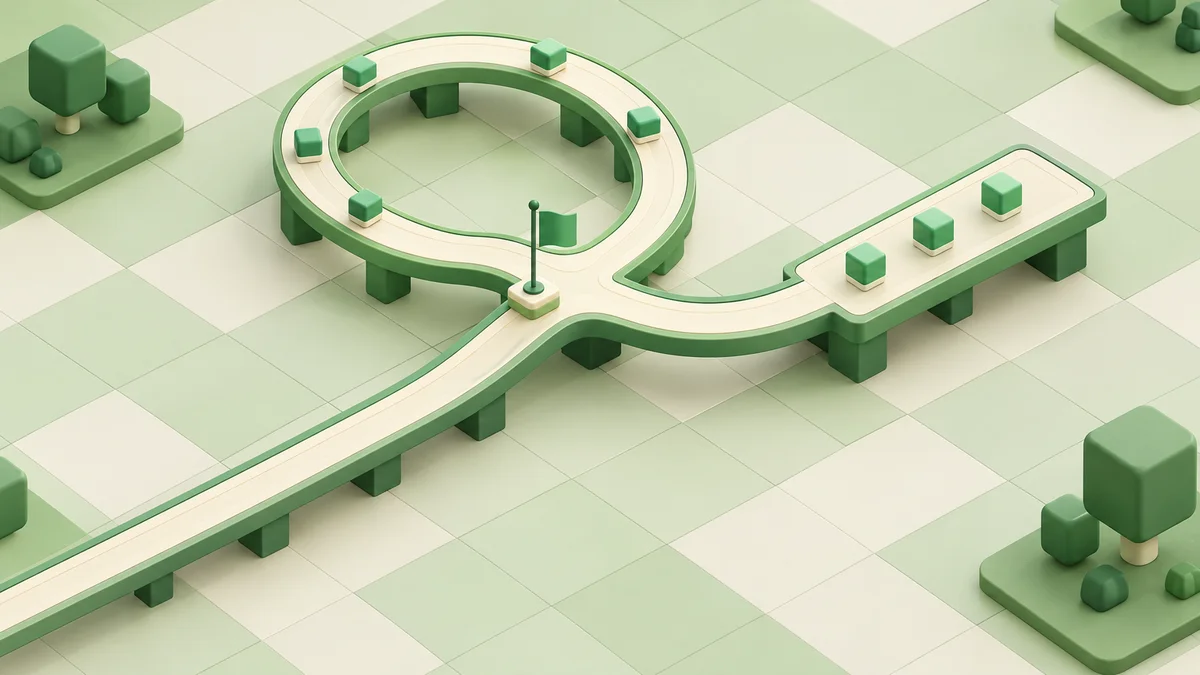
Post-sale stages follow the same rule as pre-sale stages: name the event. A record becomes a customer at closed-won and moves to active use after kickoff and a first value event. It enters expansion when a usage signal or customer request opens an upsell deal. It becomes at-risk when a health flag is set, churned when the contract ends unrenewed, and win-back when a new deal opens on a churned account.
Gross revenue retention (GRR) is the share of recurring revenue kept from existing customers after churn and downgrades, before any expansion. Net revenue retention (NRR) is the same measure after expansion is added back. Benchmarkit's calendar-2025 data shows median GRR at 84%, down from 88% in 2024, while median NRR edged up to 102% from 101% (Benchmarkit, as tabulated by Digital Applied, 2026). Expansion is covering for churn, so churn and expansion need separate stage definitions.
The same benchmark carries a warning. "When expansion crosses 40%, it signals substitution for new logo growth, not amplification of it." (Benchmarkit, 2026) Lifecycle reporting should show new-logo and expansion pipeline separately so one cannot hide weakness in the other.
Expansion share differs by go-to-market motion: a median 54% of new ARR for hybrid companies, 41% for sales-led and 36% for product-led (Benchmarkit, as tabulated by Digital Applied, 2026). One lifecycle model has to handle all three paths.
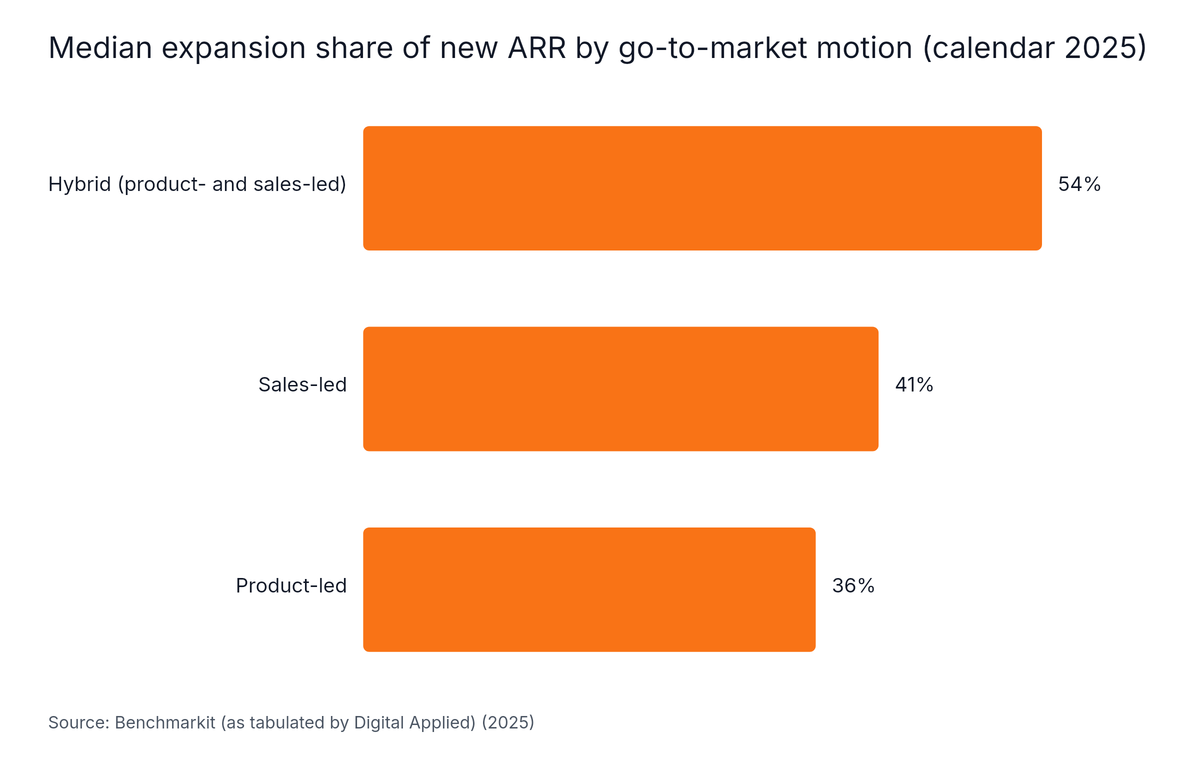
Source: Benchmarkit (as tabulated by Digital Applied), 2025
New-customer ARR also costs more to win than expansion ARR: a $1.63 new-customer CAC ratio against $0.80 for expansion per $1 of ARR in calendar 2025 (Benchmarkit, as tabulated by Digital Applied, 2026). Maxio's benchmark report makes the process point: "Very few B2B SaaS companies apply the same rigor of process, measurement or focus on expansion ARR as they do New logo ARR." (Maxio, via Digital Applied, 2025)
Retention differs by contract size. SaaS Capital's 2025 benchmarks, as reported by SaaS Magazine, show median NRR of 98% below $12,000 annual contract value (ACV), 102% in both the $25,000 to $50,000 and $100,000 to $250,000 bands, and 106% above $250,000 (SaaS Capital, 2025). A September 2026 SaaS Magazine teardown argues NRR is five different metrics across ten SaaS companies because definitions differ (SaaS Magazine, 2026). Finance, customer success and RevOps should sign one written NRR definition alongside the stage definitions.
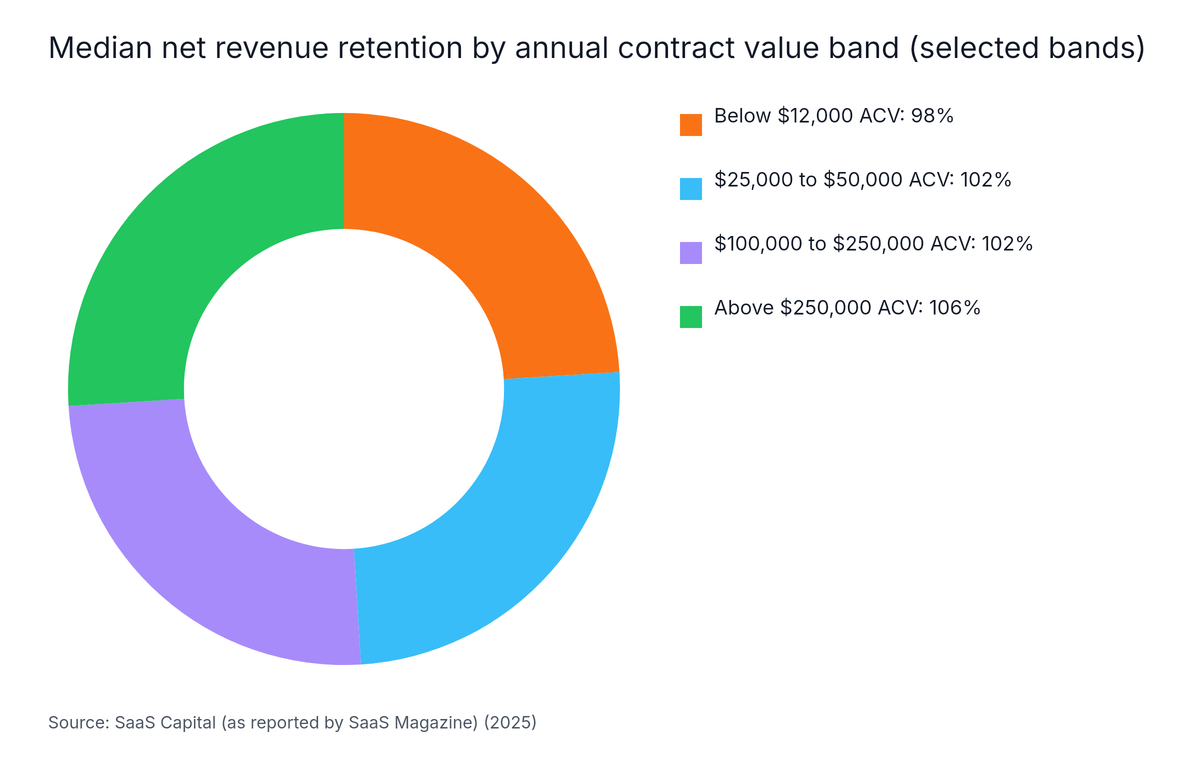
Source: SaaS Capital (as reported by SaaS Magazine), 2025
The bowtie funnel is a lifecycle shape that adds a second, post-sale half for onboarding, expansion and renewal, so it fits B2B SaaS better than a traditional funnel when expansion matters. Neither shape fixes reporting alone. The shape stays a diagram until each stage has a written entry criterion, a trigger event and an owner.
A traditional funnel ends at closed-won. The bowtie keeps going, which matches the evidence that expansion is a median 40% of net new ARR (Benchmarkit, 2026). The ten-stage table above already covers both halves.
Some practitioners criticize the bowtie for the same reason: it describes a shape but not the data model behind it. The test is practical:
If the answer is yes, the drawing matters little. If no, a bowtie, a funnel and a flywheel all produce the same disputed numbers.
RevOps should own lifecycle stage definitions because revenue operations works across marketing, sales and customer success and administers the CRM. RevOps writes the criteria, records them in one glossary and approves changes, which gives both teams the same stage counts.
Marketing-qualified lead (MQL) is a lead that meets the agreed score or firmographic threshold for sales follow-up. Sales-qualified lead (SQL) is a lead that sales has confirmed has a need, authority and a buying reason. Published conversion rates for these stages vary because each source defines them separately.
| Source | Metric | Published figure | Note |
|---|---|---|---|
| First Page Sage, 2025 | B2B SaaS lead-to-opportunity | 6.2% | Agency client data, own six-step funnel |
| GrowthSpree, April 2026 | Median MQL to SQL, B2B SaaS Google Ads | 13% to 18% | Published range, defined separately from other sources |
| First Page Sage, June 2025 | MQL to SQL by channel, 50+ clients | 26% paid search, 30% LinkedIn, 51% SEO | Defined separately from other sources |
Compare your conversion rate only against a source whose stage definitions you have read. For channel and stage ranges, see the B2B SaaS sales conversion benchmarks.
The cost of skipping this is measurable. Validity's survey found 37% of organizations lose revenue as a direct result of data quality, and companies lose an average of 16 sales deals per quarter (Validity, 2025). The figures are self-reported and do not establish causation.
Stage events are also the conversions that ad platforms learn from. GrowthSpree's June 2026 audit found 91% of 104 accounts had no Google click ID (GCLID) reaching the CRM, and 89% ran default attribution.
Study finding: After a 90-day attribution fix, the share of closed-won deals traced to a campaign went from 0% to 67% (GrowthSpree study, June 2026, 104 audited Google Ads accounts and $78.0M in spend).
Choosing a model comes next: the attribution models pillar compares the options, and the guide to last-touch attribution covers where single-touch credit breaks down. Tooling choices are covered in marketing attribution software.
A customer lifecycle model for B2B SaaS is not built for B2C or e-commerce companies, for companies with no sales team and no CRM yet, or for teams that want a benchmark to copy. Adopters need a CRM and a sales motion, and must adapt every criterion to their own buying process.
Several limits apply:
A B2B SaaS customer lifecycle typically includes lead, marketing-qualified lead, sales-accepted lead, sales-qualified lead, opportunity, customer, expansion, renewal, at-risk or churned, and win-back. Each stage should have a written entry criterion tied to a buyer action, a trigger event, a CRM field and a named owner so every team counts records the same way.
A lifecycle stage records where a person or account sits in the journey from first touch to renewal, while a lead status records the working state of a record inside one stage, such as attempting contact. The stage changes rarely and drives reporting. The status changes often and drives daily follow-up.
A B2B SaaS company needs as many lifecycle stages as it has distinct buyer actions, handoffs and owners. A small team can merge the sales-accepted lead stage into others and add post-sale stages later. A stage that has no unique entry criterion, trigger or owner should be removed.
Revenue operations should own lifecycle stage definitions because it works across marketing, sales and customer success and administers the CRM. Marketing and sales supply input, but RevOps writes the criteria, publishes them in one glossary, approves changes and audits records that skip stages.
Track lifecycle stages at both levels but report revenue from the account. Person-level stages guide marketing follow-up for each contact, while an account-level stage reflects the furthest real progress across all contacts. Written rules must say which object holds each stage and how conflicts between contacts resolve.
The bowtie funnel is better suited to B2B SaaS when expansion and renewal matter, because it adds post-sale stages that a traditional funnel stops short of. Neither shape fixes reporting alone. Each stage still needs a written entry criterion, a trigger event, a CRM field and an owner.
A customer lifecycle model works when the criteria are written and one function owns them. Five points to carry forward:
One funnel. One set of definitions. One number everyone trusts. To pressure-test your stage definitions against your own CRM, bring the funnel and the reporting question to a free consultation: Meet with an expert.
Written by
Ishan Manchanda
Ishan Manchanda is co-founder of GrowthSpree, a B2B SaaS marketing consultancy founded in 2017 that has managed $60M+ in ad spend across 300+ B2B SaaS companies. He focuses on demand generation, go-to-market strategy and pipeline growth, and has been featured in Silicon Valley Times, SaaS Mag and the Unbounce podcast.
| Expansion | An existing customer has an open upsell or cross-sell deal | Usage signal or customer request | Deal pipeline = Expansion | Customer success or account management |
| Renewal | Contract end date falls inside the renewal window | Renewal date reached | Renewal date on the subscription | Customer success |
| At-risk or churned | Health signal drops, or the contract ends unrenewed | Risk flag set or contract end passes | Account status | Customer success, confirmed by finance |
| Win-back | A churned account re-engages and a new deal opens | New deal created on a churned account | Lifecycle stage = Win-back | Sales |