ICP vs Buyer Persona in B2B SaaS: How Each Is Used in RevOps
icp vs buyer personaideal customer profilebuyer persona
ICP vs Buyer Persona in B2B SaaS: How Each Is Used in RevOps
ICP vs buyer persona: an ICP sets routing, territories and pipeline filters by company fit, while personas shape messaging. See where each lives in the RevOps stack.
Ishan ManchandaNov 20, 2026
Last updated: Nov 20, 2026
ICP vs Buyer Persona in B2B SaaS: How Each Is Used in RevOps
An ideal customer profile (ICP) is a description of the company most likely to buy and stay, while a buyer persona describes the people inside it; in B2B SaaS, revenue operations (RevOps) uses the ICP for routing and the persona for messaging.
Request a quote and our experts will contact you within 24 hours with tailored solutions and pricing.
Marketing says 400 leads came in. Sales says 30 were real. Often the cause is routing built on who the lead is (a job title) instead of what the company is (its fit). This page draws the operational line in the icp vs buyer persona debate, and shows which object, field and owner each one belongs to. For the wider function, see the RevOps software stack guide.
Key Takeaways
An ideal customer profile (ICP) defines company fit and drives lead routing, territory design and pipeline filters in B2B SaaS RevOps.
A buyer persona defines the roles inside a buying group and drives messaging, not routing.
ICP fit belongs on the CRM account object; persona or role tags belong on the contact or lead object.
Forrester puts a typical business buying decision at 13 internal stakeholders plus nine external influencers (2026), so account-level routing beats single-persona routing.
ICP rules are only as reliable as the CRM data behind them: 76% of CRM users say less than half of it is accurate and complete (Validity, 2025).
What Is the Difference Between an ICP and a Buyer Persona?
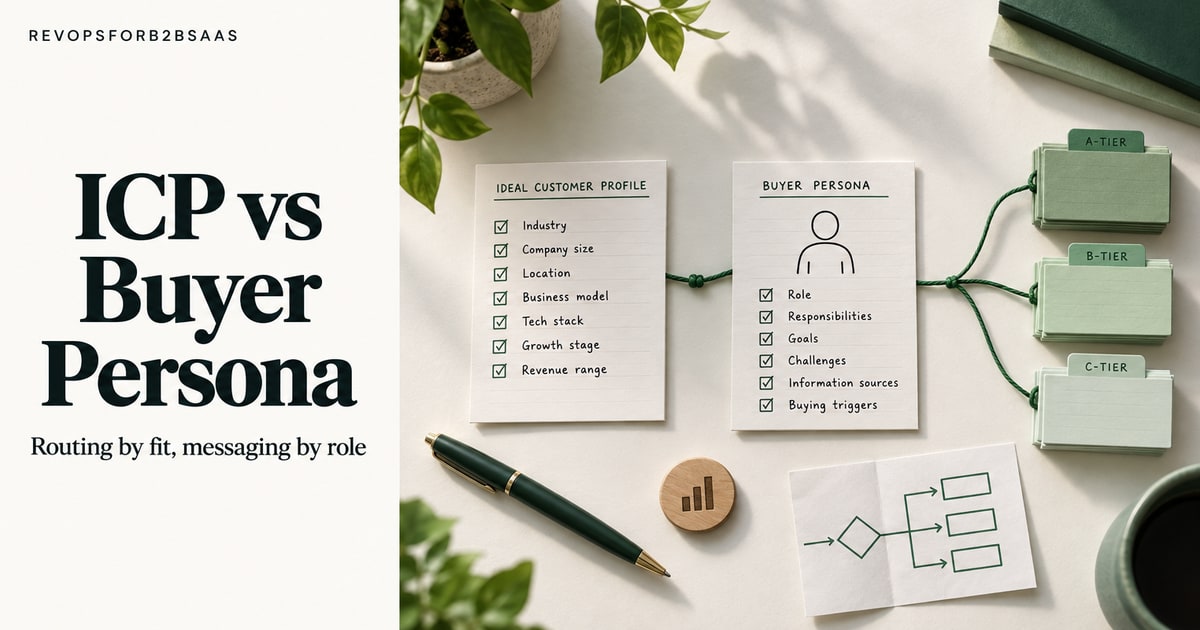
An ideal customer profile (ICP) describes the type of company most likely to buy, retain and expand, using firmographic fit criteria. A buyer persona describes the people inside those companies: their roles, goals and concerns. In RevOps, the ICP drives routing, territories and pipeline filters, while buyer personas drive messaging.
Firmographic data is company-level information such as industry, employee count, revenue band and region. It answers "should we sell to this company?" A buyer persona is a research-based description of a role inside a buying company. It answers "what does this person care about?"
Two index cards on a desk, one with a company fit checklist and one with a person sketch
Dimension
ICP
Buyer persona
Unit of analysis
Company or account
Person or role
Core question
Is this company a fit?
What does this role need to hear?
Typical inputs
Industry, size, region, tech stack, deal history
Goals, objections, buying role, content habits
Main RevOps use
Routing, territories, pipeline filters
Messaging, sequences, content
Typical owner
RevOps
Product marketing or marketing
CRM home
Account object
Contact or lead object
The ICP comes first. As Mik Tareen of Seam AI put it, "If ICP fit tells you who your best customers are, intent signals tell you when they're ready to buy." (RevOps Co-op, 2025). Fit comes before timing, and neither is a persona.
Where Does Each Live in the RevOps Stack?
In the RevOps stack, ICP fit lives on the account object in the customer relationship management (CRM) system, fed by enrichment and read by routing and scoring. Buyer persona data lives on the contact or lead object as a role tag and in marketing automation content logic. Each field needs one system of record.
Account fields versus contact fields
Layer
ICP data
Persona data
CRM
Account: fit tier, fit score, segment
Contact or lead: role, buying-group function
Marketing automation
Fit threshold as an entry gate
Content track by role
Enrichment
Firmographic fields appended to accounts
Title normalization into role tags
Routing tool
Reads fit tier to pick owner
Reads role tag to pick sequence
A fit score measures how closely a company matches the ICP. An intent score measures readiness. Keeping them as separate fields lets routing apply an ICP gate before behavioral scoring, so an engaged but poor-fit lead does not jump the queue.
Should Lead Routing Rules Use ICP or Buyer Persona?
Lead routing rules should use ICP fit first, because company criteria such as size, industry and region decide who should own an account. Persona or job title can then pick the follow-up sequence. Routing on job title alone sends leads by demographic assumption, not by whether the company can realistically buy.
Lead routing is the set of rules that assigns an inbound lead or account to a rep or team. A failure case shows the risk. A "VP Marketing" at a 20-person company outside the ICP scores high on a title-based rule and goes straight to a senior rep. A "Coordinator" at a named target account scores low and waits in a general queue. The first lead is a poor use of senior time. The second may be the way into a deal.
A safer routing order
Match the lead to an account.
Read the account's ICP fit tier.
Assign the owner by tier, segment and territory.
Use persona or role to choose the sequence and message.
Apply intent signals to set the response priority.
Paper cards sorted into three labeled tiers on a table
How Are ICP Tiers Used for Territory Design and Pipeline Filters?
ICP tiers sort accounts into groups such as Tier 1, Tier 2 and non-ICP, based on fit score. RevOps uses the tiers to balance territories by rep capacity, set response targets by tier, and exclude non-ICP deals from pipeline coverage reports so that coverage reflects deals the team can realistically close.
Three uses stand out:
Territory design: spread Tier 1 accounts evenly across reps, so no one rep holds all the best accounts.
Response targets: set a faster target for Tier 1 inbound requests than for Tier 3.
Pipeline filters: report pipeline coverage with and without non-ICP deals, so a full pipeline of poor-fit opportunities does not hide a gap.
Personas play no part in any of these. They shape what a rep says once the account is assigned. For conversion context by stage and channel, see sales conversion rates in B2B SaaS.
Why Does Buying-Group Size Matter for Personas?
Buying-group size matters because one ICP-fit account contains many people with different concerns. Forrester puts the typical business buying decision at 13 internal stakeholders plus nine external influencers (Forrester, 2026). A single persona cannot cover that group, so personas work best as several role-aware messaging tracks inside an account-level route.
The same Forrester release reports procurement as a decision-maker in 53% of buying cycles (2026), a role most marketing personas leave out. The study draws on a survey of nearly 18,000 global business buyers. Forrester's Barbara Winters says "B2B marketers must develop dynamic, role-specific insights that capture how buyers evaluate risk, seek information, and define success" (Forrester, 2026).
The practical result: route at the account level by ICP fit, then tag each contact by role. Messaging can then adapt to the economic buyer, the user and procurement without changing who owns the account. Last-touch credit also hides this group effect, as covered in last-touch attribution in B2B SaaS.
A routing flow drawn on paper with tokens placed on branching paths
What Data Quality Does an ICP Need to Work?
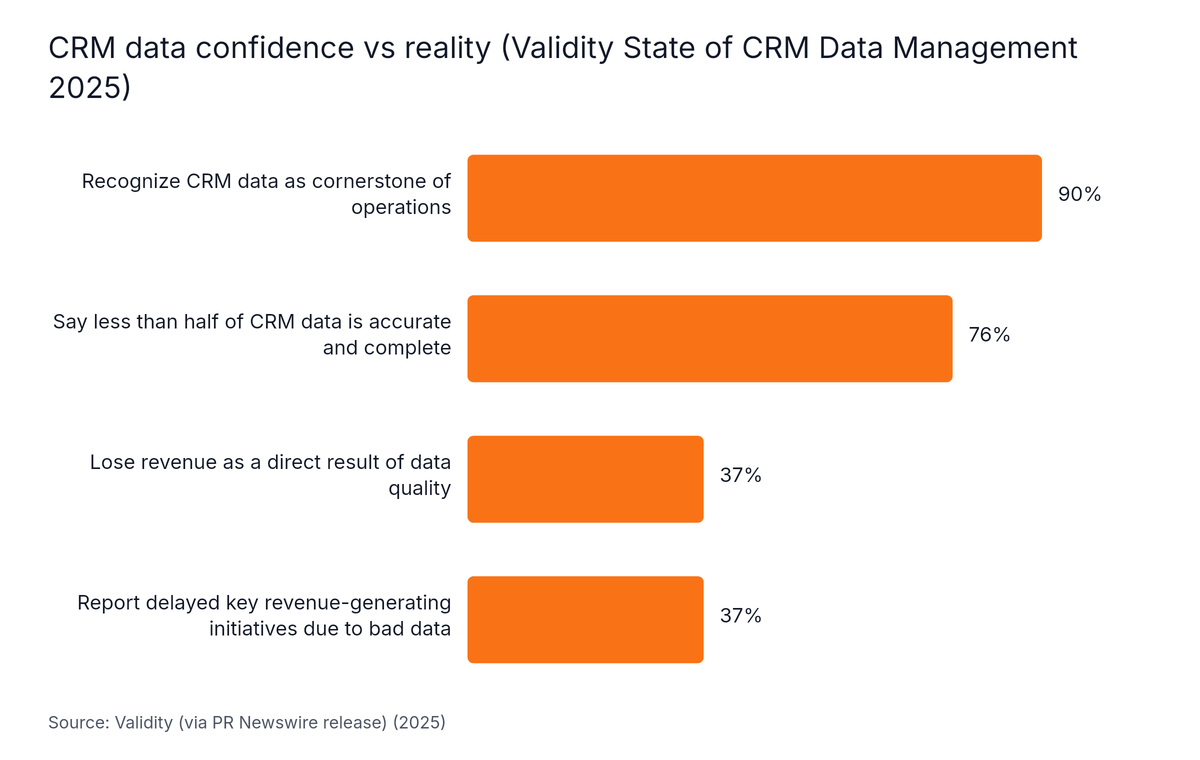
An ICP only works in routing if the firmographic fields behind it are accurate. In Validity's 2025 survey of 602 CRM users, 76% said less than half of their CRM data is accurate and complete (Validity, 2025). Without enrichment, ownership and a refresh cadence, fit rules misroute leads without anyone noticing.
Horizontal Bar chart: CRM data confidence vs reality (Validity State of CRM Data Management 2025). Highest: Recognize CRM data as cornerstone of operations at 90%.
The same survey found 37% of CRM users lost revenue as a direct consequence of poor data quality (2025). Validity's Cynthia Price noted "There's a growing gap between confidence and reality when it comes to data quality" (PR Newswire, 2025).
Ownership is a weak point. Only 18% of organizations without a full-time CRM data owner plan to hire one within twelve months (Validity via PR Newswire, 2025). A separate 2025 survey (sample size not stated) reports 99% of respondents struggle with technical data issues, and 71% of those who rated their data "good enough" say it hurt go-to-market execution (RevOps Co-op, 2025).
A minimal governance setup:
Item
ICP
Buyer persona
Owner
RevOps
Product marketing or marketing
Refresh
Quarterly, or when conversion drifts
Quarterly, or after win/loss reviews
Change log
Every routing rule change
Message and content changes
Data prerequisite
Enriched account fields
Normalized title and role tags
Who Is This Distinction Not For?
The ICP and persona split matters least for companies with no sales team and no CRM yet, and it is only partly useful at very small scale. A founder closing every deal personally can keep fit criteria in their head. The operational line pays off once routing, territories or multiple reps exist.
Three honest limits apply:
One-person teams: a single written ICP and a short role list are enough. Separate fields and tiers can wait.
Thin data: if account data is mostly blank, fit tiers will be guesses. Fix enrichment first.
Scope: this page covers operational use. It does not cover persona research methods or messaging craft.
Frequently Asked Questions
What is the difference between an ICP and a buyer persona?
An ideal customer profile (ICP) describes the type of company most likely to buy, retain and expand, using firmographic fit criteria. A buyer persona describes the people inside those companies: their roles, goals and concerns. RevOps uses the ICP for routing, territories and pipeline filters, and uses personas to shape messaging.
Should lead routing rules use ICP or buyer persona?
Lead routing rules should start with ICP fit, because company size, industry and other firmographic criteria decide which rep or team owns the account. Persona or job title can refine who follows up or which sequence runs, but it should not be the first gate.
Which should be built first, ICP or buyer persona?
The ICP should be built first. It defines which companies are worth pursuing, and personas are then researched for the roles inside those companies. Building personas first often produces messaging aimed at people at companies that never convert.
Where do ICP fit scores live in the CRM?
ICP fit scores belong on the account object, because fit is a property of the company. Persona or role tags belong on the contact or lead object. Leads inherit the account's fit tier through matching, so routing can read one consistent field.
How often should an ICP or buyer persona be refreshed?
Review both on a fixed cadence, such as quarterly, and also when conversion rates drift. Record each change to routing rules in a change log, so a shift in closed-won patterns can be traced to a specific update.
Conclusion
The ICP and the buyer persona do different jobs, and RevOps works best when each has its own field, owner and place in the stack.
Use the ICP for routing, territories and pipeline filters.
Use buyer personas for messaging across the buying group.
Store fit on accounts and role on contacts.
Keep fit and intent as separate scores.
Review both quarterly and log every routing change.
To check where your own routing rules rely on title instead of fit, bring your CRM setup to a free call. For the team structure around this work, see consultant versus internal RevOps hire. Meet with an expert.
Written by
Ishan Manchanda
Ishan Manchanda is co-founder of GrowthSpree, a B2B SaaS marketing consultancy founded in 2017 that has managed $60M+ in ad spend across 300+ B2B SaaS companies. He focuses on demand generation, go-to-market strategy and pipeline growth, and has been featured in Silicon Valley Times, SaaS Mag and the Unbounce podcast.
 Ishan Manchanda