last touch attributionlast touch attribution modellast touch vs multi touch attribution
Last-Touch Attribution: Definition, How It Works, and Where It Breaks Down in B2B SaaS
Last-touch attribution gives 100% of deal credit to the final touchpoint. Learn what it is, how it works, and why it distorts budget decisions in B2B SaaS.
Request a quote and our experts will contact you within 24 hours with tailored solutions and pricing.
revopsforb2bsaas.com
Last updated: Oct 21, 2026
Last-Touch Attribution: Definition, How It Works, and Where It Breaks Down in B2B SaaS
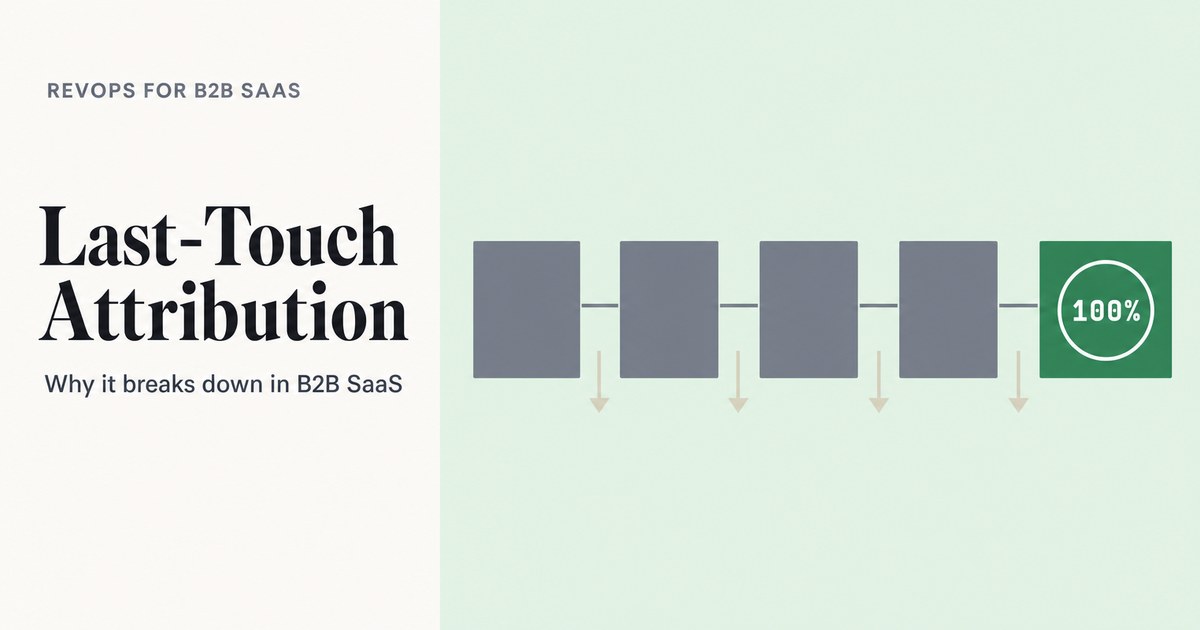
Last-touch attribution is a measurement model that assigns 100% of revenue or conversion credit to the final marketing touchpoint a prospect interacted with before converting, giving zero credit to every earlier channel in the buyer journey. In B2B SaaS, where sales cycles stretch across weeks and buying committees include multiple stakeholders, this default setting systematically distorts budget decisions: branded search collects credit for deals that paid or organic channels originated long before.
A data point illustrates the scale of the problem. Across 104 audited Google Ads accounts representing $78.0M in spend, 89% ran default attribution without any change (GrowthSpree, June 2026). That means most B2B SaaS teams are making channel-investment decisions based on a model designed for a single-session purchase.
This page defines last-touch attribution, walks through a concrete deal example, explains why it fails on an 84-day sales cycle, and compares it with multi-touch and first-touch alternatives. The FAQ section covers Facebook-specific and social-channel attribution questions.
Key Takeaways
Last-touch attribution assigns 100% of deal credit to the final touchpoint before conversion; all earlier channels receive zero.
89% of 104 audited B2B SaaS accounts ran default (last-touch) attribution without modification (GrowthSpree, June 2026).
On an 84-day median sales cycle, the final touchpoint is rarely the channel that created awareness or intent.
Branded search and direct traffic systematically over-collect credit under last-touch models, skewing budget away from demand-generation channels.
A combination of multi-touch attribution and a self-reported channel field produces more actionable budget signals than last-touch alone.
What is last-touch attribution and how does it work?
Last-touch attribution is a measurement model that assigns 100% of the revenue or conversion credit to the final marketing touchpoint before a prospect converts. Every earlier interaction, whether a paid ad, a content piece, or a webinar, receives zero credit. It is the default setting in most customer relationship management (CRM) platforms, which is why 89% of 104 audited B2B SaaS Google Ads accounts ran it without change (GrowthSpree, June 2026).
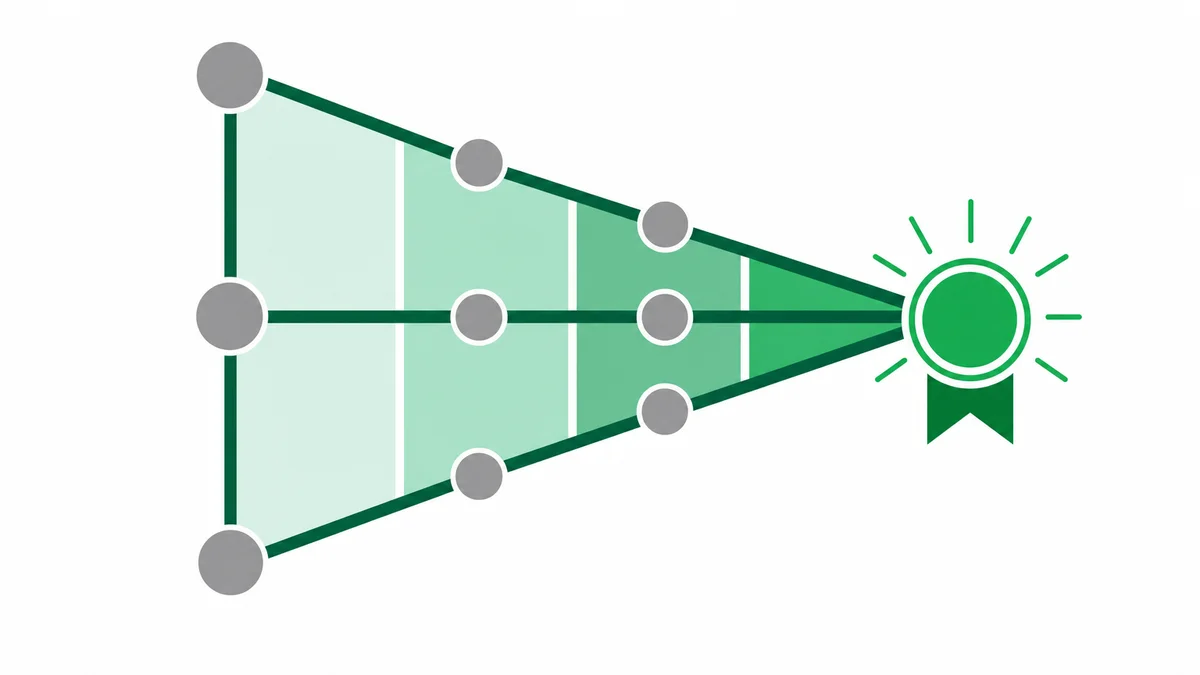
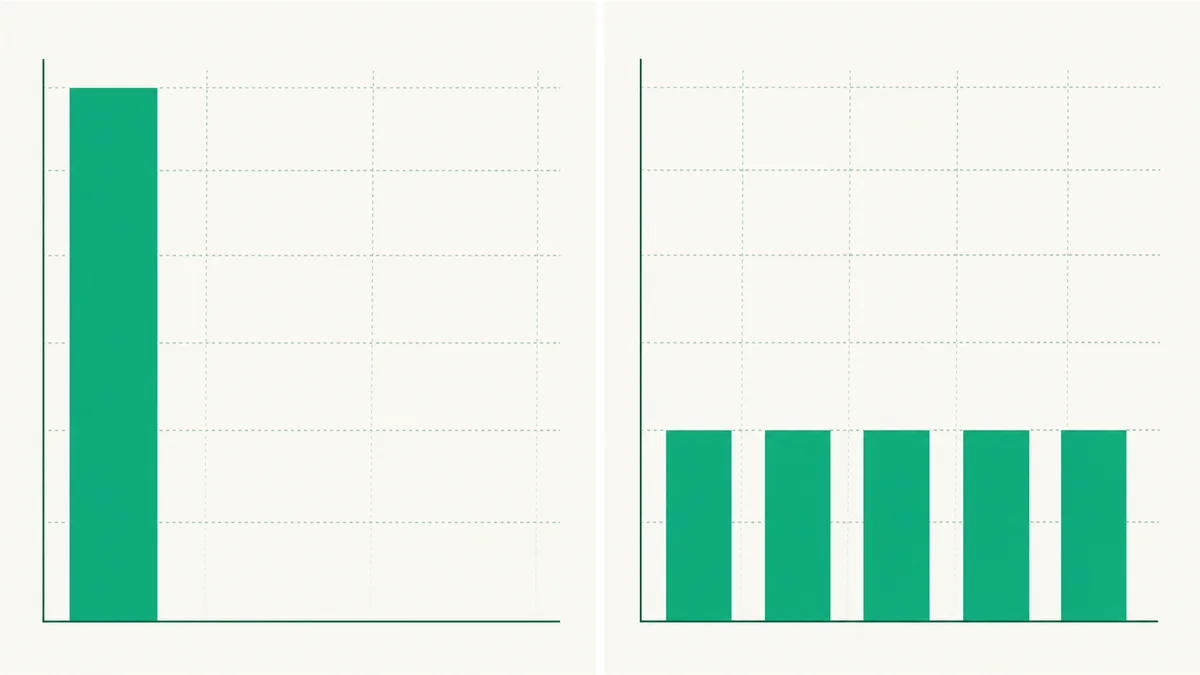
Flat vector diagram of a single touchpoint receiving full attribution credit
Last-touch attribution is defined by one rule: whichever channel or campaign a buyer touched immediately before submitting a form or booking a demo receives the full conversion credit. The model is simple to implement because every CRM records the traffic source at lead creation, and that value is carried forward to the opportunity and closed-won record without further configuration.
Multi-touch attribution is the alternative family of models that distributes credit across more than one touchpoint. Last-touch sits at the opposite end of that spectrum from first-touch, which credits only the initial channel.
The model's appeal is its simplicity. No weighting rules, no path analysis, no complex data joins. For e-commerce or single-session purchases, where a buyer finds a product and buys it in one sitting, last-touch is often accurate enough. For B2B SaaS, where the journey from first impression to closed deal spans weeks, it is structurally inadequate.
Last-touch in Google Ads and CRM platforms
Google Ads moved from last-click as its default model to data-driven attribution, which uses machine learning to distribute credit across touchpoints based on observed conversion paths. Google no longer supports linear, time decay, or position-based models in the platform. However, most CRM platforms, including HubSpot and Salesforce, still default to recording the most recent traffic source on the lead record, which is a CRM-side last-touch model operating independently of whatever the ad platform uses.
These two systems can therefore report different attribution outcomes for the same deal: the ad platform uses data-driven attribution within its own ecosystem, while the CRM applies last-touch based on the UTM parameter or referrer captured at form submission.
How does last-touch attribution work inside a CRM and ad platform?
Last-touch attribution works by recording the most recent campaign parameter or traffic source attached to a lead record at the moment of form submission or conversion event, then carrying that source value forward to every deal and closed-won record linked to that contact. In Google Ads, last-click was the longstanding default before data-driven attribution became the platform default; CRM platforms such as HubSpot and Salesforce still default to last-touch source tracking unless reconfigured.
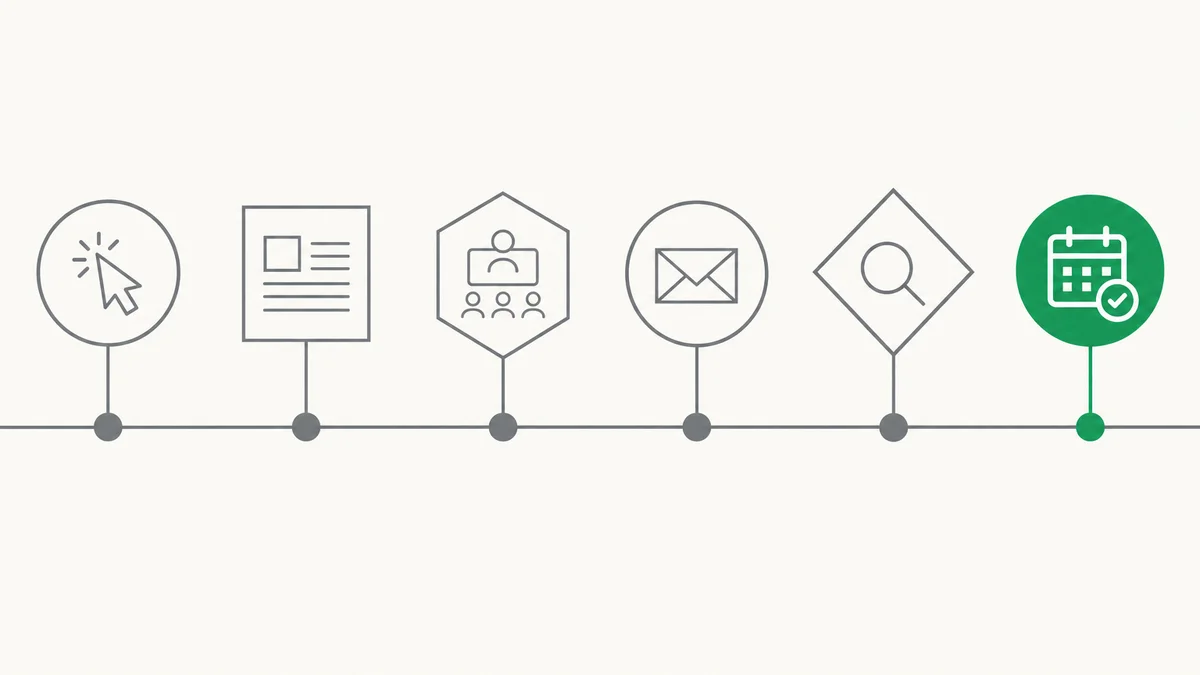
Flat vector timeline of a B2B SaaS deal with six touchpoints over 84 days
When a prospect fills in a demo request form, the CRM captures the UTM parameters on the page URL, or falls back to the HTTP referrer if no UTM is present. That source value, say utm_source=google and utm_campaign=branded, becomes the lead's attributed source. If the same contact later becomes an opportunity and then closes, that CRM-side source label follows the deal through every stage.
What the CRM records and what it misses
What CRM last-touch captures
What CRM last-touch misses
Traffic source at first form submission
All earlier channel interactions
Campaign and medium at the moment of conversion
Content consumed before the form
Final UTM parameters if present
Previous sessions under different devices or browsers
Referrer if no UTM is set
Interactions by other buying-committee members
The table above shows a structural gap. A prospect who clicked a LinkedIn ad two months ago, returned directly three times, and finally submitted a form after a branded Google search will have their CRM record show "Google / Branded" as the source. The LinkedIn campaign that started the conversation disappears from the record entirely.
The missing data compounds when Google click IDs (GCLIDs) are not stored in the CRM. A GCLID is the parameter Google appends to a landing page URL when a visitor arrives via a Google Ads click; it links the CRM lead record back to the specific ad, keyword, and campaign. Across 104 audited accounts, 91% had no GCLID reaching the CRM (GrowthSpree, June 2026). Without the GCLID, even last-touch attribution from paid search cannot trace back to a specific campaign.
What does a last-touch attribution example look like in a real B2B SaaS deal?
In a typical B2B SaaS deal tracked under last-touch attribution, a prospect may have clicked a LinkedIn ad in week one, read an organic blog post in week three, attended a webinar in week six, and then searched the brand name on Google and clicked a branded search ad in week twelve before booking a demo. Last-touch attribution credits the branded search campaign with 100% of the closed-won deal value; the LinkedIn ad, blog post, and webinar receive zero.
Flat vector comparison of last-touch versus multi-touch credit distribution
Here is that journey mapped against what each model records:
Touchpoint
Week
Channel
Last-Touch Credit
First-Touch Credit
Multi-Touch Credit (equal weight)
LinkedIn paid ad click
1
Paid social
0%
100%
25%
Organic blog post
3
Organic search
0%
0%
25%
Webinar registration
6
Email / event
0%
0%
25%
Branded Google search
12
Paid search (branded)
100%
0%
25%
The table makes the distortion visible. The LinkedIn campaign that introduced the prospect to the product gets zero credit. The branded search ad that the prospect used when they had already decided to book a demo gets everything.
For a revenue operations (RevOps) team reviewing pipeline by source, this result is directly misleading. If the report shows that branded search produced the deal, the logical budget response is to increase branded search spend and reduce LinkedIn spend. But the demand that made branded search possible was created by LinkedIn.
Our data: After a 90-day attribution fix across 104 audited accounts, the share of closed-won deals traced to a campaign went from 0% to 67% (GrowthSpree, June 2026). The fix involved storing GCLIDs in the CRM and sending qualified stages back to the ad platform as offline conversions.
Why last-touch attribution breaks down on a long B2B SaaS sales cycle
Last-touch attribution breaks down in B2B SaaS because the channel a buyer uses at the moment of conversion is rarely the channel that built awareness or intent. Across 104 audited accounts, the median sales cycle was 84 days (GrowthSpree, June 2026). On an 84-day cycle with multiple stakeholders, the final touchpoint is almost always a low-friction closing action such as branded search or a direct visit, not the demand-generation channel that started the process.
Flat vector icon set showing branded search credit bias problem
Three structural features of B2B SaaS make last-touch attribution particularly unreliable.
1. Long sales cycles
An 84-day median means the average deal has dozens of opportunities for touchpoints between first impression and form submission. Last-touch collapses all of that into one data point. The channel that introduced the buyer to the product in week one is invisible to the model.
2. Multi-stakeholder buying committees
Published ranges with no stated sample suggest 5 to 8 stakeholders are involved in $25K to $100K B2B SaaS contracts (GrowthSpree, 2026, no sample stated). Each stakeholder may encounter the product through a different channel: one from a LinkedIn post, another from an analyst mention, another from a colleague's recommendation. Last-touch attribution records only the session of whichever stakeholder submitted the final form.
3. The branded search problem
When a buyer who has already made a decision searches for the company name and clicks a branded ad before booking a demo, branded search collects the credit. This is not a signal that branded search created the demand. It is a signal that the buyer used search as a navigation tool at the end of a decision they had already largely made. Budget decisions based on this signal favour closing channels at the expense of the demand-generation channels that created the intent.
The downstream effect on data quality is significant. Across the same 104 accounts, 78% of form fills never became a marketing-qualified lead (MQL) or sales-qualified lead (SQL) (GrowthSpree, June 2026). Last-touch attribution applied to those form fills produces source data for conversions that never represented qualified demand, further distorting the channel picture.
Last-touch versus multi-touch attribution: what is the difference?
Last-touch attribution assigns all credit to one touchpoint; multi-touch attribution distributes credit across every touchpoint in the buyer journey using a defined weighting rule. Multi-touch models include equal weighting across all touches, time-decay weighting that gives more credit to recent touches, and position-based weighting that splits credit between first and last touch with the middle shared. Multi-touch gives budget owners visibility into which channels built pipeline, not just which channel closed it.
The practical difference shows up in budget decisions. Cost per sales-qualified lead (SQL) tracked pipeline at a correlation of 0.71 across 1,412 ad variants (GrowthSpree, June 2026), meaning the campaigns that produced qualified pipeline were measurably different from the campaigns that produced clicks. Last-touch attribution, which measures the final click, cannot surface that distinction. Multi-touch attribution, applied consistently with qualified stages, can.
Model
Credit rule
What it shows
What it hides
Last-touch
100% to final touchpoint
Closing channel
All demand-generation channels
First-touch
100% to first touchpoint
Awareness channel
All nurture and closing channels
Equal-weight multi-touch
Equal share to every touch
All channels proportionally
Relative importance of each touch
Time-decay multi-touch
More credit to recent touches
Closing channels, less so openers
Early awareness channels
Position-based multi-touch
40% first, 40% last, 20% middle
First and last channels
Middle-of-funnel channels
Data-driven (Google Ads default)
ML-weighted by observed paths
Channels that statistically correlate with conversion
Channels outside the ad platform's data
Google Ads now uses data-driven attribution as its default and no longer supports last-click, linear, time decay, or position-based models within the platform. Data-driven attribution operates inside the Google Ads ecosystem only. For cross-channel reporting in the CRM, teams still need a deliberate approach to how source is recorded and maintained.
Is first-touch or last-touch attribution better for B2B SaaS reporting?
Neither first-touch nor last-touch attribution alone produces reliable budget signals for B2B SaaS. First-touch attribution credits demand creation but ignores everything that moved a deal forward. Last-touch attribution credits deal closing but starves demand-generation channels of credit. With a median sales cycle of 84 days and buying committees involving multiple stakeholders, a combination of multi-touch attribution and a self-reported 'how did you hear about us' field gives a more complete picture.
Flat vector illustration of a CRM pipeline report with attribution source labels
The channel-level conversion data illustrates why this matters. Marketing-qualified lead (MQL) to sales-qualified lead (SQL) conversion rates vary by channel: 26% for paid search, 30% for LinkedIn, and 51% for organic search (SEO), based on a benchmark across 50+ clients (First Page Sage, June 2025). A separate benchmark for B2B SaaS Google Ads gives a median of 13% to 18% MQL to SQL (GrowthSpree, April 2026). The two sources define stages differently and cannot be averaged, but both show that the quality of demand varies significantly by channel.
Last-touch attribution cannot surface that variation. If paid search and organic search each produce 50 form fills, but organic search converts to SQL at twice the rate, last-touch credits whichever channel touched last, not whichever channel produced qualified demand.
A practical approach for a B2B SaaS team
Record the traffic source and UTM parameters on every lead record in the CRM at the moment of form submission.
Store the GCLID (or equivalent click parameter for other platforms) with every lead to enable offline conversion uploads.
Add a self-reported "how did you hear about us" field to the demo request form and review responses monthly.
Define at least one qualified stage (SQL or opportunity) as an offline conversion event and send it back to the ad platform.
Review pipeline by source at the SQL or opportunity stage, not at the form-fill stage, to measure demand quality rather than volume.
Where last-touch attribution reporting produces the most misleading signals
Last-touch attribution produces the most misleading signals when branded search or direct traffic are the final step in a journey that began with paid or organic demand generation. In that scenario, branded search collects credit for deals that paid social or content channels originated weeks earlier. An audit of 104 accounts found that 91% had no Google click ID (GCLID) reaching the CRM, meaning source data for most deals was missing entirely before attribution even ran (GrowthSpree, June 2026).
The specific situations where last-touch attribution is most distorting:
Content-led demand generation: A prospect reads three blog posts over six weeks, then books a demo by searching the brand name. Last-touch credits branded search; content gets nothing.
LinkedIn or social awareness campaigns: A prospect sees multiple LinkedIn posts or ads, forms intent, then converts via a retargeting ad or direct visit. Social awareness is invisible under last-touch.
Event and webinar pipelines: A prospect attends a conference session or webinar, then converts weeks later via email or direct. The event channel disappears from the attribution record.
Multi-device journeys: A prospect researches on mobile, converts on desktop. The mobile session is not connected to the desktop session in most CRM setups, so the research channel is lost.
After a 90-day attribution fix, the share of closed-won deals traced to a campaign went from 0% to 67% across the same 104 accounts (GrowthSpree, June 2026). The fix did not change which channel deserved credit. It changed whether any channel credit was recorded at all. That is a separate problem from model choice, but it compounds the last-touch distortion: bad data plus a reductive model produces a report that is doubly misleading.
When last-touch attribution is still useful
Last-touch attribution is still useful in specific, narrow situations where the buyer journey is short, the purchase involves a single decision-maker, and the conversion is direct response in nature. For self-serve or product-led growth (PLG) motions with a free trial or freemium entry point, where a visitor signs up in the same session they first encounter the product, last-touch is often accurate because the final touchpoint and the demand-creation touchpoint are the same.
For B2B SaaS teams that sell on a 30-day or longer cycle, or where enterprise deals involve three or more stakeholders, last-touch attribution provides one useful data point: which channel a buyer used at the moment of conversion. That information has value for conversion rate optimisation of landing pages and forms. It does not have value as the primary input for channel budget allocation.
Frequently Asked Questions
What is last-touch attribution?
Last-touch attribution is a measurement model that assigns 100% of the revenue or conversion credit to the final marketing touchpoint a buyer interacted with before converting. Every earlier channel interaction, paid ad, blog post, or webinar, receives zero credit. It is the default model in most customer relationship management (CRM) platforms and many ad tools.
What does last-touch attribution mean?
Last-touch attribution means that only the channel or campaign a prospect contacted immediately before filling in a form or booking a demo is credited with producing that lead or deal. If a buyer clicked a branded search ad as their final step, that campaign gets 100% of the credit regardless of what drove awareness weeks earlier.
What is the last touch attribution model and what are its limitations?
The last-touch attribution model credits the final touchpoint before conversion with 100% of deal value. Its main limitations are that it ignores every earlier channel that built awareness or intent, it over-credits branded search and direct traffic on long sales cycles, and it produces budget signals that favour closing channels at the expense of demand-generation channels.
What does last-touch attribution look like in practice with a real deal example?
A prospect clicks a LinkedIn ad in week one, reads a blog post in week three, attends a webinar in week six, and books a demo via a branded Google search in week twelve. Last-touch attribution credits the branded search campaign with the closed deal. The LinkedIn ad, blog post, and webinar receive zero credit despite influencing the decision.
What is the difference between last touch and multi-touch attribution?
Last-touch attribution gives 100% of credit to the final touchpoint before conversion. Multi-touch attribution distributes credit across every touchpoint in the buyer journey, using rules such as equal weighting, time decay, or position-based models. Multi-touch gives visibility into which channels built awareness and intent, not just which channel happened to touch last.
Is first touch or last touch attribution better for B2B reporting?
Neither first-touch nor last-touch attribution alone gives an accurate picture in B2B SaaS, where the median sales cycle is 84 days and multiple stakeholders are involved. First-touch credits demand creation; last-touch credits deal closing. Both ignore the middle of the journey. A combination of multi-touch attribution and a self-reported channel field produces more actionable data.
What is the difference between first-touch and last-touch attribution for social channels?
First-touch social attribution credits the social channel that first brought a prospect into the funnel. Last-touch social attribution credits only the final social or other interaction before conversion. For social channels such as LinkedIn, where content builds awareness over weeks, first-touch or multi-touch models better capture the channel's contribution than last-touch alone.
How does Facebook handle last-touch attribution and what does it measure?
Facebook (Meta) Ads Manager uses a click-and-view attribution model with a default window of 7-day click and 1-day view. Within that window it credits the last Facebook ad interaction before a conversion event fires. Conversions that happen outside the window, or via another channel after a Facebook impression, are not counted, which means Facebook's reported results reflect only in-platform last-touch activity.
Why last touch attribution doesnt work for b2b?
Last-touch attribution fails in B2B SaaS because buying decisions involve long sales cycles, multiple stakeholders, and many channels. With a median sales cycle of 84 days across 104 audited accounts (GrowthSpree, June 2026), the channel a buyer uses at the very end is rarely the channel that created awareness or intent. Branded search and direct traffic systematically over-collect credit, skewing budget decisions away from demand-generation channels.
Conclusion
Last-touch attribution is not broken because it is poorly designed. It is broken for B2B SaaS because it was designed for a different type of purchase. On a single-session transaction, the last touchpoint and the demand-creation touchpoint are the same thing. On an 84-day B2B sales cycle with multiple stakeholders, they are almost never the same thing.
The practical consequences are specific: branded search and direct traffic over-collect credit, demand-generation channels under-collect it, and budget flows toward closing channels at the expense of the channels that create demand. With 89% of audited accounts running default attribution, and 91% missing the GCLID data needed to trace any paid click back to a closed deal, the starting point for most teams is not choosing a better model. It is fixing the data collection that any model depends on.
The right sequence is: store click IDs, define qualified stages as offline conversions, add a self-reported source field, then choose a multi-touch model that fits the reporting question. Attribution model selection without data infrastructure produces a more sophisticated report built on the same gaps.
If attribution setup or CRM source tracking is on the agenda, the RevOps for B2B SaaS editorial team offers a free consultation to work through the next step. Meet with an expert.