Blog
Conversion Path: What It Is and How to Track One Across a Long B2B Sales Cycle
A conversion path is the sequence of touches before a deal converts. See where click IDs expire and how to track a B2B SaaS path across a widely cited 84-day cycle.
Why branded search wins last-touch credit on closed-won deals, the CRM data the model needs, and the first steps B2B SaaS teams take to cut the bias.
 Ishan ManchandaNov 21, 2026

A conversion path is the sequence of touches before a deal converts. See where click IDs expire and how to track a B2B SaaS path across a widely cited 84-day cycle.

A customer lifecycle model for B2B SaaS: ten stages with entry criteria, triggers, CRM fields and owners, plus how RevOps keeps one number across teams.

ROAS definition, how ROAS differs from ROI, and why platform ROAS rarely matches closed-won revenue in B2B SaaS paid search, with a metric-by-audience guide.
Request a quote and our experts will contact you within 24 hours with tailored solutions and pricing.
Last updated: Nov 21, 2026
Last-touch attribution is a model that gives 100% of the credit for a closed-won deal to the final tracked interaction, which in B2B SaaS is often a branded search click, so budgets drift toward the channel that touches last.
The problem shows up in budget meetings. Finance sees branded search winning credit on nearly every deal, moves money toward it, and cuts the early programs that created the demand. Revenue operations (RevOps) and marketing operations teams then own a report nobody in the room questions, even though they know it is wrong.
This guide covers why the model fails structurally, the customer relationship management (CRM) data it needs, and the first steps teams take to cut the bias without throwing away history. For the wider model landscape, see attribution models in B2B marketing.
By the Editorial Team | Last updated: November 4, 2026
Key Takeaways
- Last-touch attribution credits one tracked click, so it over-rewards branded search and under-rewards the programs that created demand.
- The average B2B journey now runs 272 days, so a single final click captures a small slice of the path (Dreamdata via SalesTech Edition, 2026).
- Last-touch attribution is only as accurate as the CRM data behind it: click IDs, UTM parameters and opportunity records must survive from lead to closed-won.
- Teams reduce the bias by freezing the legacy field, adding parallel fields, and testing branded spend for incrementality.
- Finance responds to evidence built for its questions, not to a methodology debate.
The last-touch attribution challenge is that one tracked click gets all the credit for a sale shaped by many people and channels. The average B2B journey now runs 272 days with 88 touchpoints and 10 stakeholders (Dreamdata via SalesTech Edition, 2026), so the final click, often branded search, records a tiny slice.

The same Dreamdata benchmarks put the journey at 211 days in the prior report. It has grown by 61 days, and the buying committee has grown from 6.8 to 10 people. Every added person is another set of searches, conversations and visits that a single-touch model cannot see.
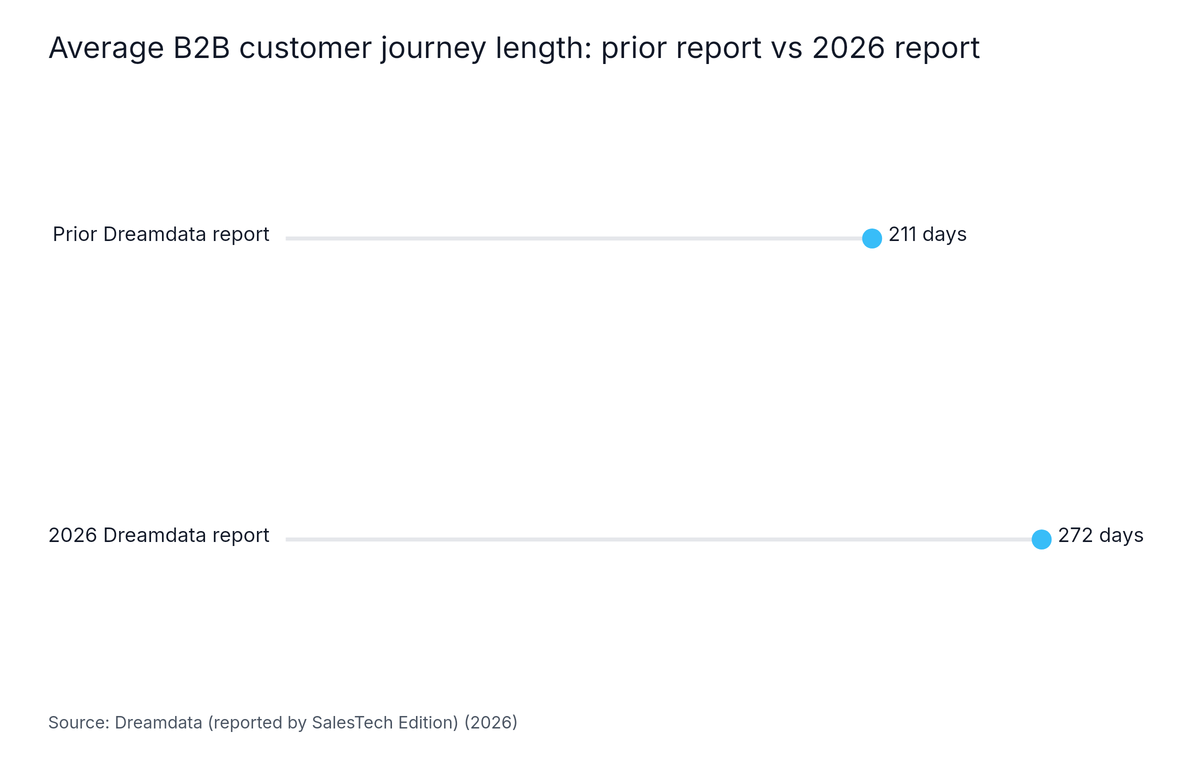
Source: Dreamdata (reported by SalesTech Edition), 2026
Dreamdata's co-founder and CMO Steffen Hedebrandt puts the result bluntly: "B2B deals are essentially won before sales get involved in the process" (Dreamdata via SalesTech Edition, 2026). Last-touch only measures what happens after that point.
First-touch attribution is a model that gives all credit to the first tracked interaction with a buyer. Each single-touch model has a built-in bias, as the table shows.
| Model | Credits | Built-in bias | Useful for |
|---|---|---|---|
| Last-touch | Final tracked interaction | Favors branded search, retargeting, direct | Tactical checks on short paths |
| First-touch | First tracked interaction | Ignores what closed the deal | Seeing which channels start journeys |
| Self-reported source | Buyer's own answer | Recall errors, free-text noise | Revealing untracked channels |
| Multi-touch | Several tracked touches | Still blind to untracked research | Cross-channel path analysis |
Neither single-touch model is better on its own, a point the FAQ below covers. For a longer look at how these models behave over a long sales cycle, see marketing attribution models.
Branded search gets last-touch credit because buyers type a vendor's name only after they have already chosen it. Buyers favor a vendor before contacting a seller, and that vendor wins 82% of the time (6sense, 2026). The branded click is the last visible step, so the model records the finish line as the cause.
Branded search is search traffic from queries that contain a company's or product's own name. It is a demand-capture channel: it converts interest that something else created.
The same 2026 6sense report finds that buying groups spend roughly 60% of an average 10.3-month cycle in the selection phase before they contact a seller (6sense, 2026). The research is also invisible by design. In Gartner's survey of 646 buyers (August to September 2025), 67% of B2B buyers prefer a rep-free buying experience, and 45% used AI during a recent purchase (Gartner via Digital Commerce 360, 2026).
Gartner analyst Alyssa Cruz describes the shift: "B2B buyers are progressing through critical buying tasks in more autonomous ways" (Digital Commerce 360, 2026). No form fill or tracked session marks most of that work.
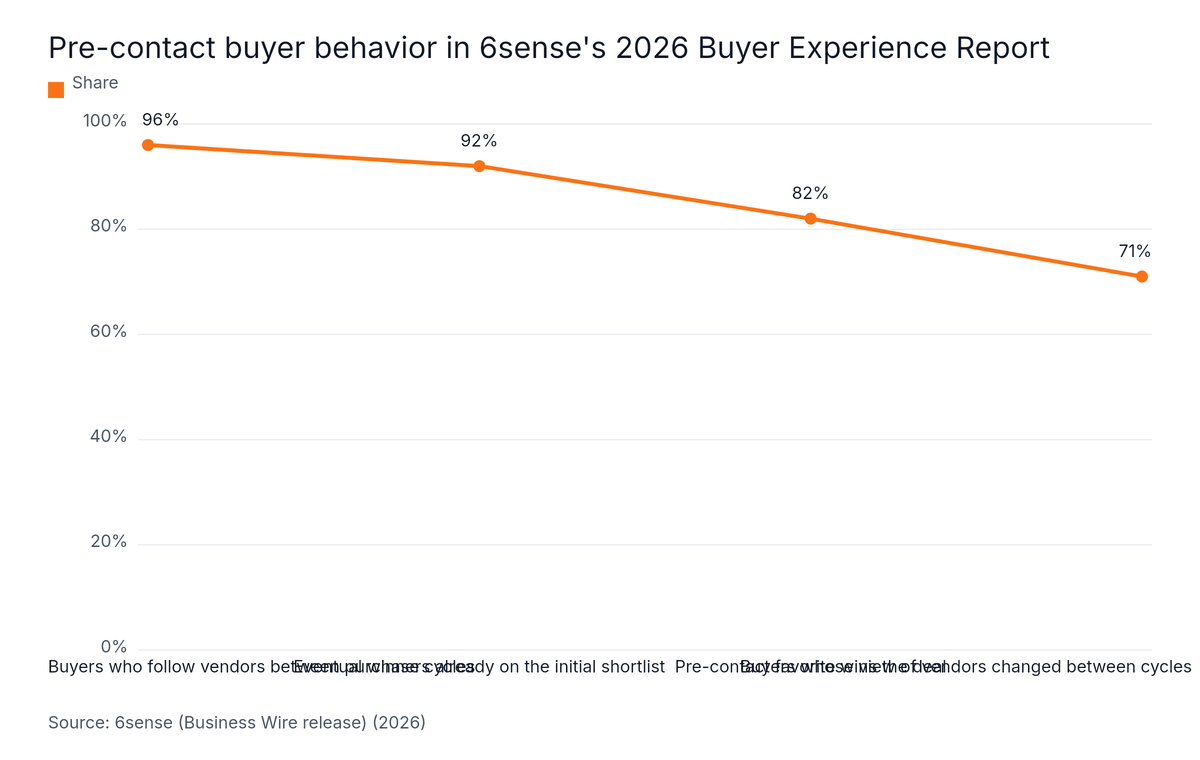
Source: 6sense (Business Wire release), 2026
A buyer reads, asks peers, compares vendors, and later searches the chosen vendor's name. Last-touch hands the credit to that final search.
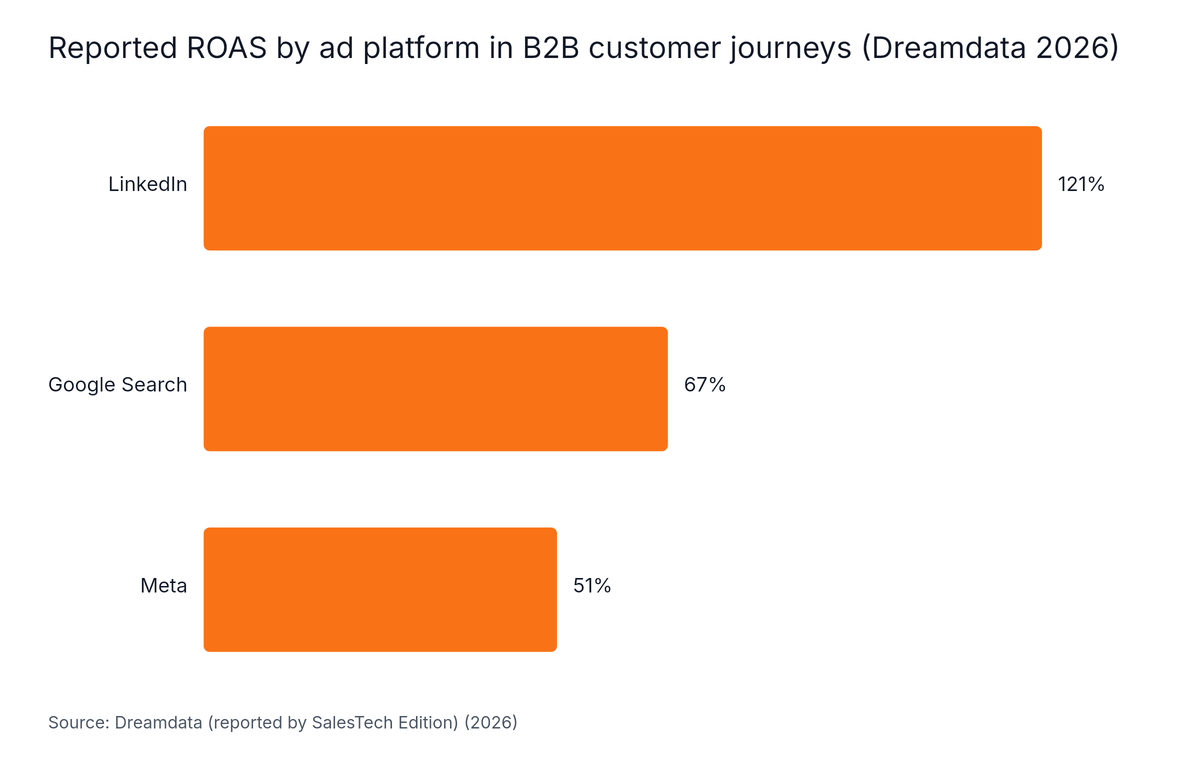
Moving budget toward branded campaigns because they hold last-touch credit funds demand capture while cutting the programs that created the demand. Channel credit depends on how touches are measured: Dreamdata's 2026 data reports return on ad spend of 121% for LinkedIn, 67% for Google Search and 51% for Meta (Dreamdata via SalesTech Edition, 2026), under its own method.

Those figures are vendor-reported under Dreamdata's own attribution method, so treat them as directional, not as a neutral benchmark. The point is the spread: the same spend looks very different depending on how touches are counted.
Source: Dreamdata (reported by SalesTech Edition), 2026
Cutting branded search blindly is also a mistake. A 2025 Haus study of branded-search incrementality tests found that 82% of brands facing high competition measured significant lift, versus 35% of those facing low pressure (Haus, 2025). Incrementality is the share of results that happened because of a marketing activity and would not have happened without it. Branded search sometimes defends against competitors and sometimes only captures demand, so it needs testing.
One caution on a vivid example: in a retailer's geo holdout, switching off Google branded search lost just seven orders, and the brand cut branded spend over 84% while keeping 99%+ of orders (Measured, 2026). That was a single direct-to-consumer case, not B2B, and the vendor itself warns that one test is a snapshot.
Reliable last-touch attribution needs click identifiers and campaign parameters captured on every form submit, stored on the lead, carried to the contact and opportunity, and joined to closed-won revenue. In GrowthSpree's June 2026 audit of 104 Google Ads accounts, 91% had no Google click ID reaching the CRM and 78% of form fills never became a sales-qualified lead.

Our data: In the June 2026 audit of 104 Google Ads accounts and $78.0M in spend, 91% had no Google click ID reaching the CRM and 89% ran default attribution. After a 90-day attribution fix, the share of closed-won deals traced to a campaign went from 0% to 67%.
A sales-qualified lead (SQL) is a lead that sales has accepted against written criteria, so a 78% gap between form fills and SQLs shows how much a raw form-fill count can mislead. The Google click ID (GCLID) is a parameter Google Ads appends to a landing page URL to identify the ad click that led to a visit. Store it, or an equivalent click parameter, with every lead. Consent for tracking is required in the European Economic Area, the UK and Switzerland, and this guide does not give legal advice.
| Field or object | Where it is captured | Why last-touch needs it |
|---|---|---|
| UTM source, medium, campaign | Hidden form fields on submit | Names the channel behind the touch |
| First-touch and last-touch values | Written once and never overwritten (first); updated on each form (last) | Lets both models run from the same record |
| GCLID or equivalent click ID | Hidden form field, stored on the lead | Joins the ad click to the CRM record |
| Persistence to contact and opportunity | Field mapping at conversion | Keeps source data alive until closed-won |
| Opportunity contact roles | Sales process | Credits the several people in a committee |
| Sales-logged calls and meetings | Activity records | Adds touches that ad platforms never see |
| Self-reported source | Form field, free text plus a picklist | Reveals untracked channels |
Data quality is the weak point. In Validity's 2025 survey of 602 CRM users, 76% said less than half of their organization's CRM data is accurate and complete, and 37% reported losing revenue as a direct consequence of poor data quality (Validity, 2025). Validity's SVP of Marketing Cynthia Price describes the cause: "There's a growing gap between confidence and reality when it comes to data quality" (Validity via PR Newswire, 2025).
For the tracking break between ad platform and CRM, see how ad click tracking breaks.
Teams reduce last-touch bias by freezing the legacy last-touch field, adding parallel first-touch, self-reported and multi-touch fields, and reporting old and new numbers side by side from a labeled cut-over date. In GrowthSpree's June 2026 audit, a 90-day attribution fix moved the share of closed-won deals traced to a campaign from 0% to 67%.

Verify it worked: closed-won records should show a populated first-touch, last-touch and self-reported value, and the branded share of credit should be reportable by month. A sound reporting dashboard for marketing and sales can show the views together.
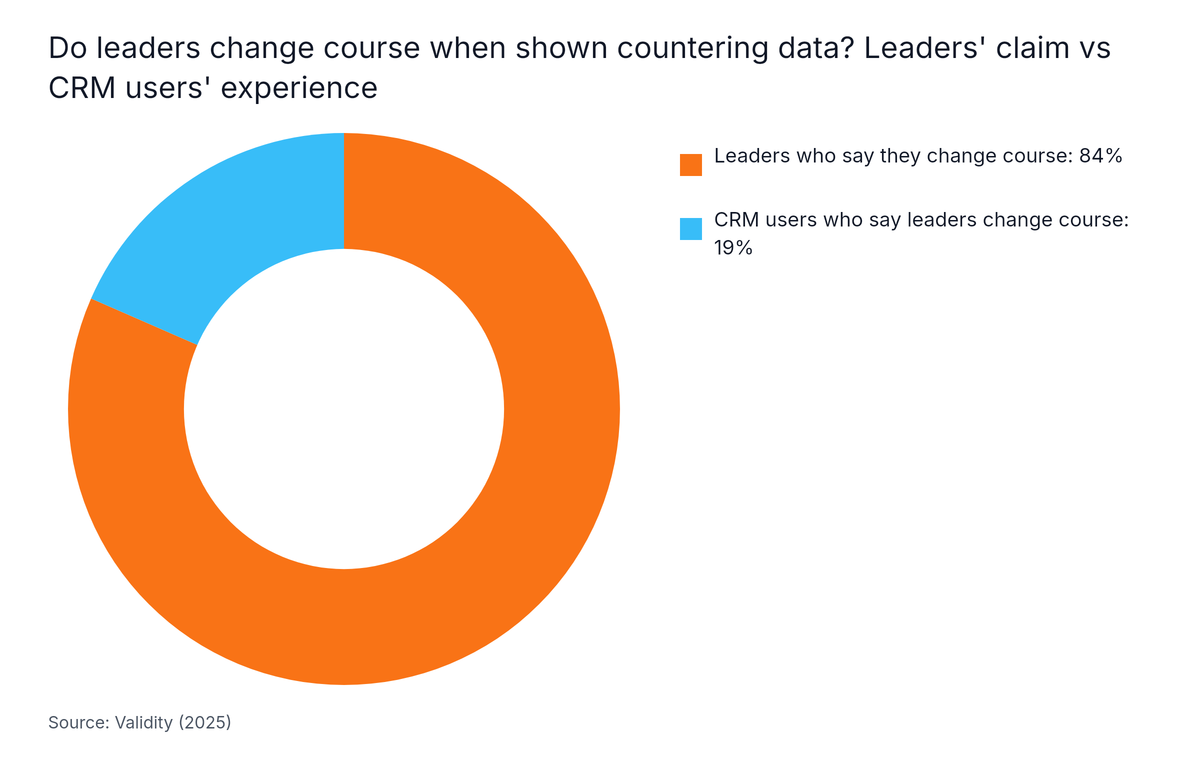
Finance moves when the evidence is designed for its questions. Only 19% of CRM users say leaders change course when shown countering data, though 84% of leaders say they do (Validity, 2025).
Source: Validity, 2025
Present the new view as an addition. The legacy last-touch report stays, and a second report shows what it cannot see. Three exhibits tend to work:
Lead with the gap, not the blame. Show finance that the branded click is real and counted, then show what came before it.
Last-touch attribution is a poor fit for sales-led B2B SaaS teams with long cycles, buying committees and heavy offline touches, but it works as a tactical check on short, single-channel conversion paths. Dreamdata's 2026 benchmarks put the average buying committee at 10 stakeholders, up from 6.8 (Dreamdata via SalesTech Edition, 2026).
Last-touch still earns a place in a few cases:
It does not fit when the buying committee is large, when research happens off tracked channels, or when sales logs calls and meetings the model never reads. Models that read from the CRM also inherit its flaws, which is why the data checklist comes first. For where the model breaks down in more detail, see the last-touch attribution definition guide.
Teams keep last-touch as one labeled view and add a self-reported source field, first-touch and multi-touch fields, and a branded versus non-branded split of closed-won credit. They then run an incrementality test on branded spend and show finance the side-by-side results from a stated cut-over date. Historical last-touch data stays frozen, not deleted.
No tool is recommended by default here. Tools fall into categories: CRM-native reporting, B2B journey and attribution platforms, and incrementality or marketing mix vendors. Choose by the data each needs from the CRM, how it handles offline sales touches, and whether it can report old and new models side by side. Check each vendor's own documentation. See marketing attribution software for B2B SaaS for evaluation criteria.
Neither is better, because both give all credit to a single touch. Last-touch favors channels near conversion, such as branded search and retargeting. First-touch favors discovery channels but ignores what closed the deal. Used together with a self-reported source field, they bracket the truth better than either model does alone.
Accurate last-touch attribution needs the GCLID and UTM parameters captured on every form submit, stored on the lead, kept through contact and opportunity records, and joined to closed-won revenue. Add opportunity contact roles, sales-logged calls and meetings, and a self-reported source field. Without these, the model reads blank or default values.
Last-touch attribution can only credit touches it can see, and it credits only one. B2B journeys span many stakeholders, long cycles and untracked research, so the final tracked click, often a branded search, absorbs credit earned earlier. The model also depends on CRM data that is frequently incomplete.
Before last-touch attribution gives reliable results, the CRM needs populated source fields on every lead, click IDs and UTM values that persist to the opportunity, contact roles on opportunities, logged sales activity, and a clear rule for unknown sources. Audit a sample of closed-won records first, and fix blanks before trusting any report.
Last-touch attribution is not useless, but it is a narrow view that rewards the channel closest to the finish line. Teams that fix the problem keep the old numbers and add better ones beside them.
Next step: bring your CRM fields and your last closed-won source report to a free consultation and map the first three changes. One funnel. One set of definitions. One number everyone trusts.
Meet with an expert
Written by
Ishan Manchanda
Ishan Manchanda is co-founder of GrowthSpree, a B2B SaaS marketing consultancy founded in 2017 that has managed $60M+ in ad spend across 300+ B2B SaaS companies. He focuses on demand generation, go-to-market strategy and pipeline growth, and has been featured in Silicon Valley Times, SaaS Mag and the Unbounce podcast.