
Blog
Conversion Path: What It Is and How to Track One Across a Long B2B Sales Cycle
A conversion path is the sequence of touches before a deal converts. See where click IDs expire and how to track a B2B SaaS path across a widely cited 84-day cycle.
Compare multi touch attribution tools with last-click for a B2B SaaS funnel: what to test, trade-offs, branded search, and how to migrate safely.
 Ishan ManchandaNov 19, 2026

A conversion path is the sequence of touches before a deal converts. See where click IDs expire and how to track a B2B SaaS path across a widely cited 84-day cycle.

A customer lifecycle model for B2B SaaS: ten stages with entry criteria, triggers, CRM fields and owners, plus how RevOps keeps one number across teams.

ROAS definition, how ROAS differs from ROI, and why platform ROAS rarely matches closed-won revenue in B2B SaaS paid search, with a metric-by-audience guide.
Request a quote and our experts will contact you within 24 hours with tailored solutions and pricing.
Last updated: Nov 19, 2026
By the RevOps for B2B SaaS Editorial Team | Published November 4, 2026
Multi-touch attribution tools split credit for a closed-won deal across every tracked touchpoint, while last-click attribution gives all credit to the final click, so the right choice for a B2B SaaS funnel depends on cycle length and data quality. The usual starting point is a blank source field: in a June 2026 audit of 104 Google Ads accounts, 91% had no click ID reaching the CRM (GrowthSpree, June 2026). A model cannot credit what was never recorded. This guide covers what each model measures, what a fair software comparison should test, and how to migrate without losing history. It builds on the wider guide to attribution models in B2B marketing.
Key Takeaways
- Multi-touch attribution tools credit only the touchpoints a CRM and tracking setup actually record, so fixing source capture comes before choosing a tool.
- Last-click attribution is simple and auditable but credits one event on a journey that Dreamdata's 2026 benchmark puts at 88 tracked touchpoints.
- A fair comparison runs both models on the same closed-won cohort, with a lookback window longer than the sales cycle, and checks results with a holdout test.
- Migrating from last-click to multi-touch safely means freezing the old last-touch field, running both models in parallel, and backfilling blank sources.
Multi-touch attribution tools fix blank closed-won sources only after the customer relationship management (CRM) system captures click IDs and source data, because a tool can credit only what the CRM records. A June 2026 audit of 104 Google Ads accounts found 91% had no Google click ID (GCLID) reaching the CRM (GrowthSpree, June 2026). After a 90-day fix, traced closed-won deals rose from 0% to 67%.

The Google click ID (GCLID) is the parameter Google Ads appends to a landing page URL to identify the ad click.
Our data: The June 2026 GrowthSpree audit of 104 Google Ads accounts ($78.0M in spend) found 91% had no GCLID reaching the CRM and 89% ran default attribution. After a 90-day attribution fix, the share of closed-won deals traced to a campaign went from 0% to 67%.
The order of work matters. Capture the click ID and source on every lead, send qualified stages back to the ad platform, and only then compare tools. A tool layered on empty source fields produces confident charts built on gaps. The mechanics are covered in how ad click tracking breaks between the platform and the CRM.
Once capture works, the tool's job is to stitch and write back. Use this table as a capability check, not a vendor ranking.
| Capability | What to check | Why it matters for blank sources |
|---|---|---|
| CRM write-back | Source and touch data return to the CRM record | Blank source fields shrink over time |
| Click ID handling | GCLID or equivalent stored per lead | Ties the closed-won deal to the ad click |
| Account-level stitching | Several contacts roll up to one company journey | Matches how committees buy |
| Offline stage return | SQL and opportunity stages sent to ad platforms | Bidding learns from qualified outcomes |
| Model transparency | Rules or weights can be inspected | Lets finance and sales audit the credit |
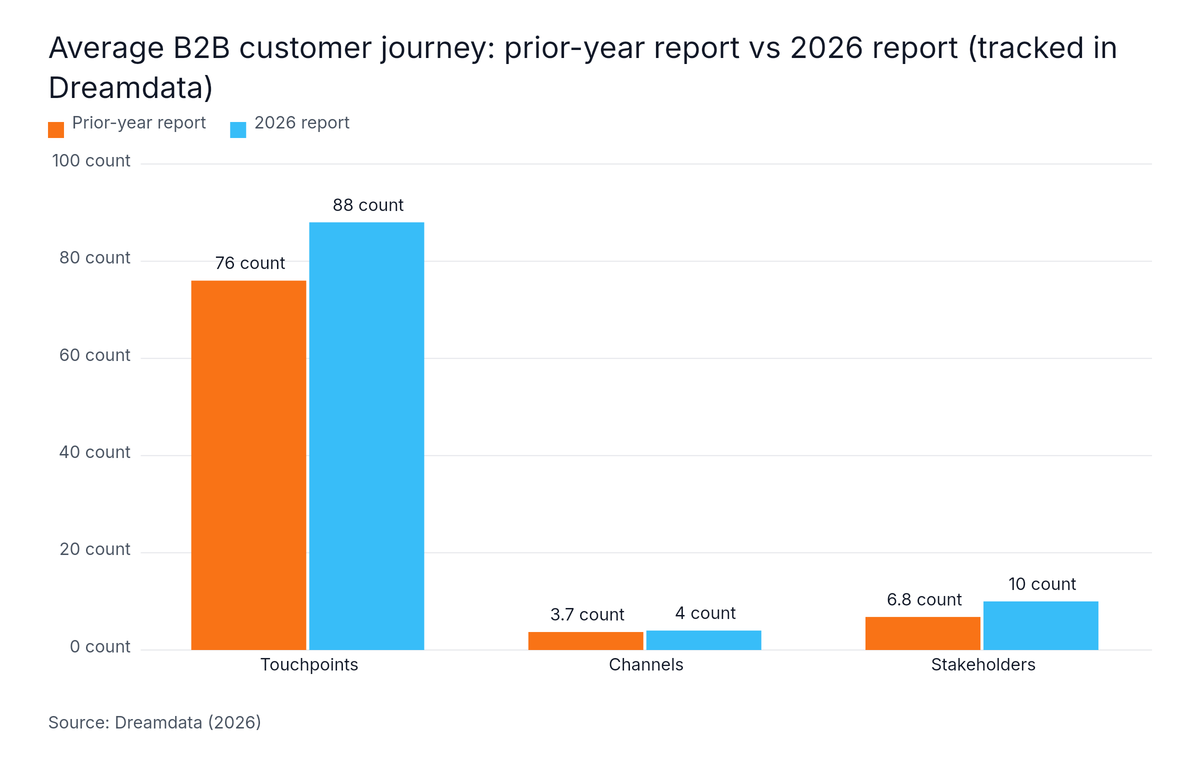
The main trade-off between multi-touch and last-click attribution is simplicity against coverage. Last-click is easy to audit but credits one event, while multi-touch spreads credit across a journey that Dreamdata's 2026 benchmark puts at 88 tracked touchpoints and 10 stakeholders, at the cost of tracking effort and model assumptions.
Source: Dreamdata, 2026
Dreamdata's 2026 report, a vendor benchmark of tracked journeys, shows touchpoints rising from 76 to 88 and stakeholders per deal from 6.8 to 10 in one year (Dreamdata, 2026). Treat "5 to 10 touches" as loose shorthand. Touches, people and tracked touchpoints are different counts, and sources do not agree on one number.
| Factor | Last-click | Multi-touch |
|---|---|---|
| Setup effort | Low | Medium to high |
| Auditability | High, one field | Lower, depends on model rules |
| Coverage of long journeys | Poor | Better, for tracked touches only |
| Risk of over-crediting branded search | High | Lower, not zero |
| Fit for board reporting | Easy to explain | Needs a stated method |
Neither model is exact. The IAB's 2026 State of Data report warns that "Advanced measurement is falling short on its core promises, while the cost of failure had never been higher" (The Measure, 2026). The IAB survey covers ad-industry decision-makers, not B2B SaaS, so read it as a caution, not a benchmark.
Last-click attribution is a method that gives 100% of the credit for a conversion to the final click before it. Multi-touch attribution is a method that splits credit for a conversion across several tracked touchpoints instead of one. Neither measures cause. Both describe where credit lands under a rule. The last-touch attribution write-up shows where the single-touch side breaks.
| Method | What it credits | What it needs | Main blind spot |
|---|---|---|---|
| Last-click | The final tracked click | One source field on the lead | Earlier touches get nothing |
| Multi-touch | Several tracked touchpoints, by rule or algorithm | Contact-level and account-level journey data | Untracked touches and model assumptions |
| Self-reported ("how did you hear about us") | What the buyer remembers | One form field | Memory bias, free-text noise |
| Incrementality test | The lift a channel adds | A holdout or geo split | Needs volume and a clean design |
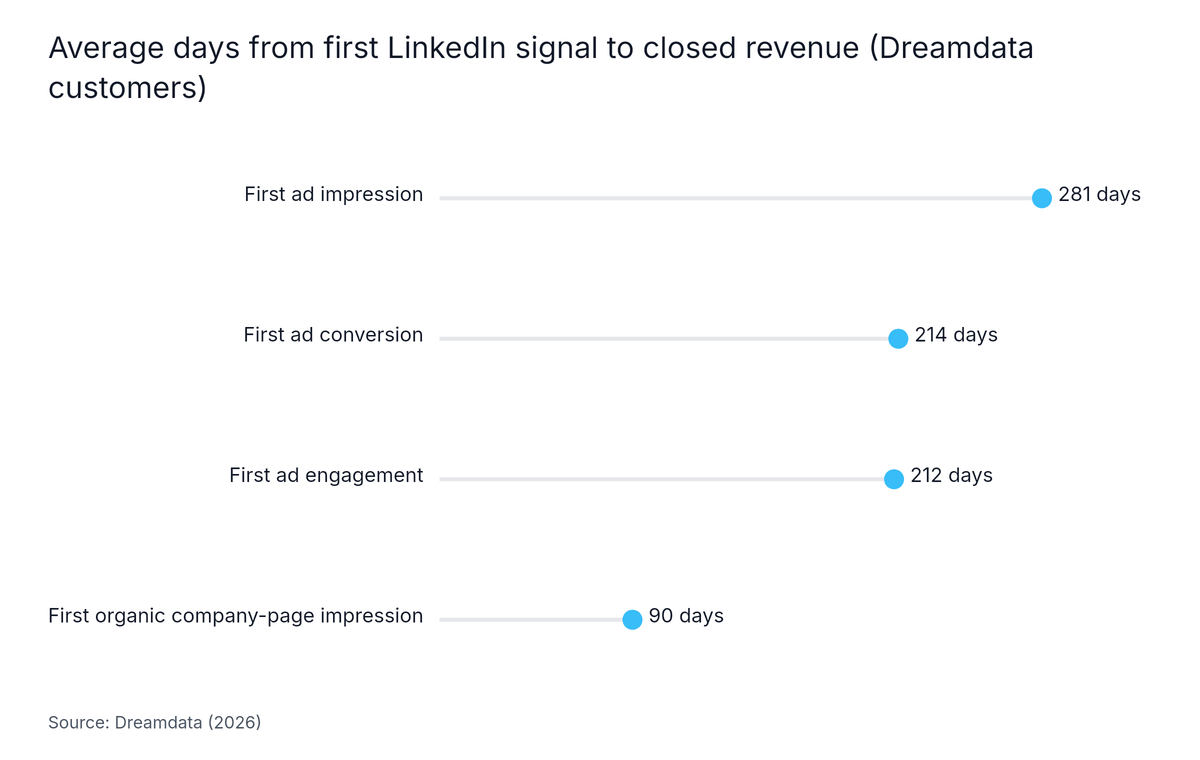
A software comparison for multi-touch attribution tools on a 90-day B2B SaaS cycle should run last-click and multi-touch side by side on the same closed-won cohort, with a lookback window longer than 90 days, account-level stitching, and a holdout check. Dreamdata's 2026 report puts first LinkedIn ad impression to revenue at 281 days.
Source: Dreamdata, 2026
A lookback window is the number of days before a conversion in which touchpoints are eligible for credit. Dreamdata's 2026 report puts first ad conversion at 214 days and first ad engagement at 212 days before revenue, while a buying-committee member's organic company-page visit was followed by close in about 90 days (Dreamdata, 2026). A 90-day window would cut off most paid influence. The June 2026 GrowthSpree audit cites a median sales cycle of 84 days across its 104 accounts, so a window of 120 days or more is a reasonable starting test.
Use this checklist when comparing software:
Vendor pages give minimum-volume and price thresholds, but no independent data backs them. Ask each vendor for its documentation and the date it was read. The marketing attribution software evaluation guide lists what to check before buying.
B2B SaaS teams should use multi-touch attribution instead of last-click when deals involve several people and channels over weeks, and the budget decision concerns the mix of paid and organic rather than one channel. Forrester's 2026 buyer survey puts a typical purchase at 13 internal stakeholders and nine external participants.

Forrester summarizes its survey of nearly 18,000 buyers: "On average, 13 internal stakeholders and nine external participants influence buying decisions" (Forrester, 2026). Last-click still works for short, single-channel motions, or as a sanity check beside a richer model.
Boards ask which channels drive pipeline. Last-click shows which channel got the final touch before the deal, and multi-touch shows which channels helped along the way. Show both, label them, and state the method. Only 49% of senior leaders can clearly articulate their measurement approach to the board (MarTech Edge, 2026). A one-page method note beats a prettier chart. The RevOps reporting dashboard guide shows what marketing and sales should view together.
Branded search wins last-click credit because buyers type the company name after earlier touches create the demand, and multi-touch attribution moves part of that credit back to those earlier touches. How much moves is unproven: no verified B2B source quantifies the effect, so a brand-term pause or incrementality test should confirm it.
Source: EMARKETER (Haus 2026 Marketing Decision Confidence Index), 2026
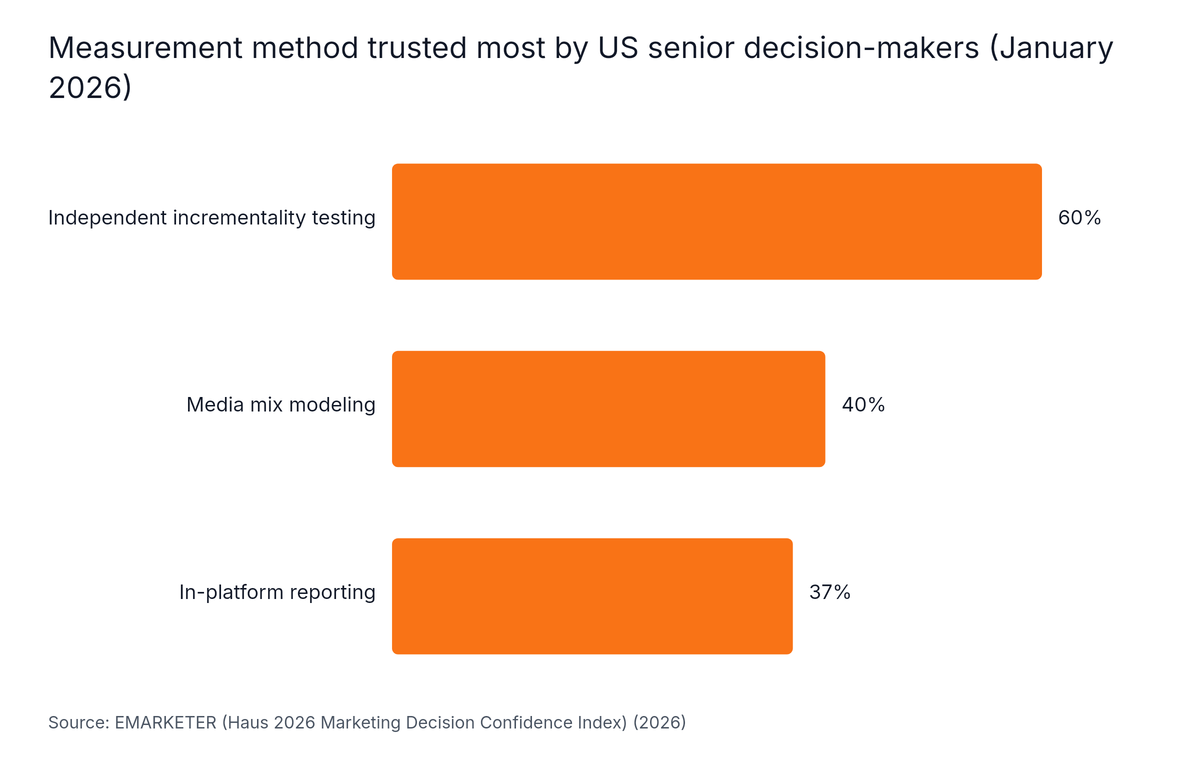
Incrementality testing is a controlled experiment that measures what a channel adds beyond what would have happened without it. In a January 2026 survey of 500 US senior decision-makers, 60% trusted independent incrementality testing most, against 40% for media mix modeling and 37% for in-platform reporting (EMARKETER, 2026). The survey was commissioned by an incrementality vendor, so weigh it accordingly.
A practical branded-search check:
If pipeline barely moves, branded search was harvesting demand that other channels created.
Moving from last-click to multi-touch safely means keeping the old last-touch field frozen, running both models in parallel for at least one sales cycle, and filling blank sources on closed-won deals first. In the June 2026 GrowthSpree audit of 104 Google Ads accounts, a 90-day fix lifted traced closed-won deals from 0% to 67%. These steps are an editorial recommendation, not a verified standard.

The June 2026 GrowthSpree audit reports a median sales cycle of 84 days across its 104 accounts, so one full parallel run takes roughly three months. Google moved custom offline uploads to the Data Manager API from June 15, 2026. That is a platform rule, so confirm the current method in Google's own documentation before building any offline stage return.
| Step | Action | Why it protects history |
|---|---|---|
| 1. Freeze the legacy field | Keep the original last-touch source read-only | Past reports stay comparable |
| 2. Fix capture first | Store the GCLID or equivalent on every new lead and send qualified stages back | Blank sources stop growing |
| 3. Add a self-reported field | Add "how did you hear about us" to forms and sales calls | Fills blanks on deals with no CRM source |
| 4. Backfill contact roles | Add opportunity contact roles to closed-won deals | Allows account-level stitching |
| 5. Run both models in parallel | Log where credit differs by channel for one full cycle | Shows the real shift before any switch |
| 6. Validate and switch | Check shifts against a holdout test, then promote multi-touch for budget decisions | Keeps the legacy field as a reference |
Before touching any analytics setting, check the vendor's documentation on whether a model change alters past reports, and note the date you read it.
Multi-touch attribution is not for teams with too little tracked data, no sales team in the CRM, or an expectation of exact answers. The IAB's 2026 State of Data survey found 60% to 75% of buy-side users say advanced measurement falls short on rigor, timeliness, trust or efficiency (IAB, 2026), so even well-built models stay directional.

Skip a new tool for now if:
Only tracked touches are credited. Dark-funnel activity such as word of mouth and private communities stays invisible, which is why self-reported attribution, a "how did you hear about us" field, belongs beside any model. Much of the trust data above is vendor-commissioned or drawn from paid-media-heavy samples, so triangulate rather than rely on one method.
Incrementality testing is the main validation method, not another attribution tool. A holdout or geo test shows what a channel adds beyond what would have happened anyway. In a January 2026 survey of 500 US decision-makers, 60% trusted incrementality testing most (EMARKETER, 2026). Self-reported source fields and a brand-term pause test add cheaper cross-checks.
Last-click shows which channel got the final touch before a deal, while multi-touch shows which channels contributed along the path to pipeline. Boards usually need the second view, but only 49% of senior leaders can clearly articulate their measurement approach to the board (MarTech Edge, 2026). Present both views side by side and state each model's limits.
The lookback window should be at least as long as the sales cycle, and longer if paid media starts influence early. Dreamdata's 2026 report found an average of 281 days from first LinkedIn ad impression to closed revenue (Dreamdata, 2026). A 90-day window would miss most of that influence, so test 120 days or more.
Multi-touch attribution does not have to replace last-click completely. A sensible approach is to keep last-click as a frozen legacy field and run multi-touch in parallel for decisions. Dreamdata's 2026 benchmark of 88 tracked touchpoints per journey shows last-click alone under-describes buying, while the legacy field keeps old closed-won reports comparable for at least one full sales cycle.
Google Analytics 4 attribution options, and whether a model change alters past reports, should be confirmed in Google Analytics Help, because the secondary sources reviewed conflict and none is a Google document. Record the date you checked the documentation, and treat any single model, including last-click, as one input rather than a verdict.
No independent data sets a minimum conversion count for multi-touch attribution. Vendor pages quote thresholds, but none state a method, so treat them with caution. With low volume, rely on a self-reported source field, a frozen last-touch field and holdout tests, then revisit a model once closed-won deals are numerous enough to compare credit by channel.
Choosing between multi-touch attribution and last-click is less about the model than about the data behind it. Validation is within reach: 52% of US brand and agency marketers already use incrementality testing and experiments, per a July 2025 EMARKETER and TransUnion survey (EMARKETER, 2026).
One funnel. One set of definitions. One number everyone trusts. To work through a CRM source gap or a model test with a specialist, Meet with an expert.
Written by
Ishan Manchanda
Ishan Manchanda is co-founder of GrowthSpree, a B2B SaaS marketing consultancy founded in 2017 that has managed $60M+ in ad spend across 300+ B2B SaaS companies. He focuses on demand generation, go-to-market strategy and pipeline growth, and has been featured in Silicon Valley Times, SaaS Mag and the Unbounce podcast.