Revenue Operations News for B2B SaaS: Where to Follow It
Where RevOps practitioners follow revenue operations news: named communities, publication types, release-note feeds and a weekly routine for a first hire.
Request a quote and our experts will contact you within 24 hours with tailored solutions and pricing.
Revenue Operations News for B2B SaaS: Where to Follow It
By the RevOps for B2B SaaS Editorial Team. Last updated: November 4, 2026.
Revenue operations (RevOps) news is the mix of peer communities, independent publications and vendor update feeds that RevOps practitioners in B2B SaaS use to track changes in tools, data practices and the scope of their role.
Revenue operations (RevOps) is the function that aligns marketing, sales and customer success around a shared funnel, one set of stage definitions and one set of metrics. A first RevOps hire at a Series A company usually has no one down the hall to ask. The stack changes monthly, and nobody at the company can say which updates matter. This guide names the communities, source types and update channels practitioners use, then turns them into a short weekly routine. If you are still deciding whether to hire at all, start with consultant versus internal hire.
Key Takeaways
Revenue operations news comes from four source types: peer communities, independent publications, analyst or survey research, and vendor release notes.
RevOps Co-op, RevGenius, Wizards of Ops and Pavilion are the communities most often named by practitioners, and they differ by cost, vetting and seniority focus.
In a 2025 Wakefield Research study for Salesloft, 89% of 400 U.S. decision-makers said RevOps lacks clearly defined strategic goals (Salesloft, 2025), which is why outside peers matter.
A solo RevOps hire can stay current in 30 minutes a week by capping inputs: one community, two newsletters, one or two release-note feeds.
Membership counts for RevOps communities are self-reported and conflict between sources, so size is a weak reason to pick one.
Where do RevOps practitioners follow revenue operations news?
Revenue operations news is the stream of community discussion, newsletters, analyst research and vendor release notes that tells a RevOps team what is changing in tools, data and role scope. Practitioners follow it in four places: peer communities, independent publications, platform update channels such as release notes, and sponsored research read with its method in mind.
A RevOps manager reading a printed newsletter beside a laptop at a cafe table in morning light
The four source types do different jobs. Mixing them gives coverage, and relying on one gives blind spots. The pace justifies the habit: 87% of 400 U.S. decision-makers in the 2025 Wakefield Research study plan increased RevOps investment (Salesloft, 2025).
Source type
What it tells you
Main risk
Peer communities
How other practitioners solved the same setup problem
Unverified advice, vendor chatter
Independent newsletters and podcasts
Curated news with a practitioner's view
Individual bias, uneven schedule
Analyst and survey research
Benchmarks and role trends
Sponsor bias, unstated sample
Vendor release notes and changelogs
What changed in a system you run
Marketing language, volume
What newsletters and podcasts should a new RevOps hire follow?
A new hire can start with examples from each type, without treating any as the one right choice. Podcasts: the RevOps Revolution podcast, hosted through Revcast. Practitioner blogs: the Revenue Wizards blog and the Openprise blog. Community research: RevOps Co-op's survey reports. Monthly or weekly roundup digests also exist; pick one that names an author, dates every item and says what to do next. This guide endorses no single feed.
How to spot sponsor bias
Vendor-sponsored research is a survey or report paid for or run by a software company, often with its own customers or contacts as respondents. It can still be useful. Check three things: the stated sample size, who was surveyed, and whether the sponsor sells the fix the report recommends.
Several studies cited here are vendor-run. Salesloft commissioned the Wakefield Research study, and Openprise ran the 2025 State of RevOps Survey with RevOps Co-op and MarketingOps. Each is labeled that way where it appears.
What are the best RevOps communities to join?
The RevOps communities most often named by practitioners are RevOps Co-op, RevGenius, Wizards of Ops and Pavilion, plus subreddits such as r/RevOps, r/salesforce and r/hubspot. They differ by cost, vetting and seniority focus. RevOps Co-op's Starter tier is free, and its Rise tier costs $63 a month billed annually (RevOps Co-op, 2026).
Small group of operations professionals chatting at a community meetup table with name cards
A peer community is a group of practitioners in the same function who share setups, questions and warnings in a forum, Slack workspace or local chapter.
Community
Gating and cost
Best fit
RevOps Co-op
Free Starter tier with community access and events; paid Rise tier at $63 a month billed annually
RevOps practitioners at any level, with local chapters
Wizards of Ops
Free but vetted Slack; excludes vendors and sales reps
Practitioners who want vendor-free discussion
RevGenius
Free
Broad go-to-market peer conversation
Pavilion
Tiers by seniority; Associate aimed at managers and directors, Pavilion Executive for VPs and above
Managers and leaders who want schools, chapters and executive peers
Subreddits
Free and open
Quick admin questions, to be checked against vendor documentation
Confirm cost and access on each community's own page before joining, since tiers change. Member counts are left out on purpose: they are self-reported, they conflict between sources, and some count all go-to-market roles instead of RevOps alone.
How do RevOps Co-op, RevGenius and Wizards of Ops differ?
RevOps Co-op, RevGenius and Wizards of Ops differ mainly in cost, vetting and audience. RevOps Co-op offers a free tier and a paid tier, Wizards of Ops is free but vetted and keeps out vendors, and RevGenius is free and broader across go-to-market roles. A practitioner who wants vendor-free answers may prefer Wizards of Ops first.
Is Pavilion worth it for a RevOps manager?
Pavilion is worth a look for a RevOps manager who wants executive peers and structured learning. It sets tiers by seniority, and its Associate tier targets managers and directors. In 2026 it launched four new GTM schools and cites 50+ local chapters (Pavilion via EIN Presswire, 2026). Check current pricing on its own page.
Why community beats a feed
A feed tells you what happened. A community tells you what it cost someone to find out. One RevOps practitioner and podcast host put it this way: "That's something that only a community can give you, because it gives you that leverage and that reach that you couldn't get otherwise." (Revcast, 2025)
How to read the subreddits
Subreddits suit quick configuration questions in a specific tool. Answers are unverified and quality varies by thread. Use them to find a lead, then confirm it in vendor documentation.
Why does a first RevOps hire need an outside peer group?
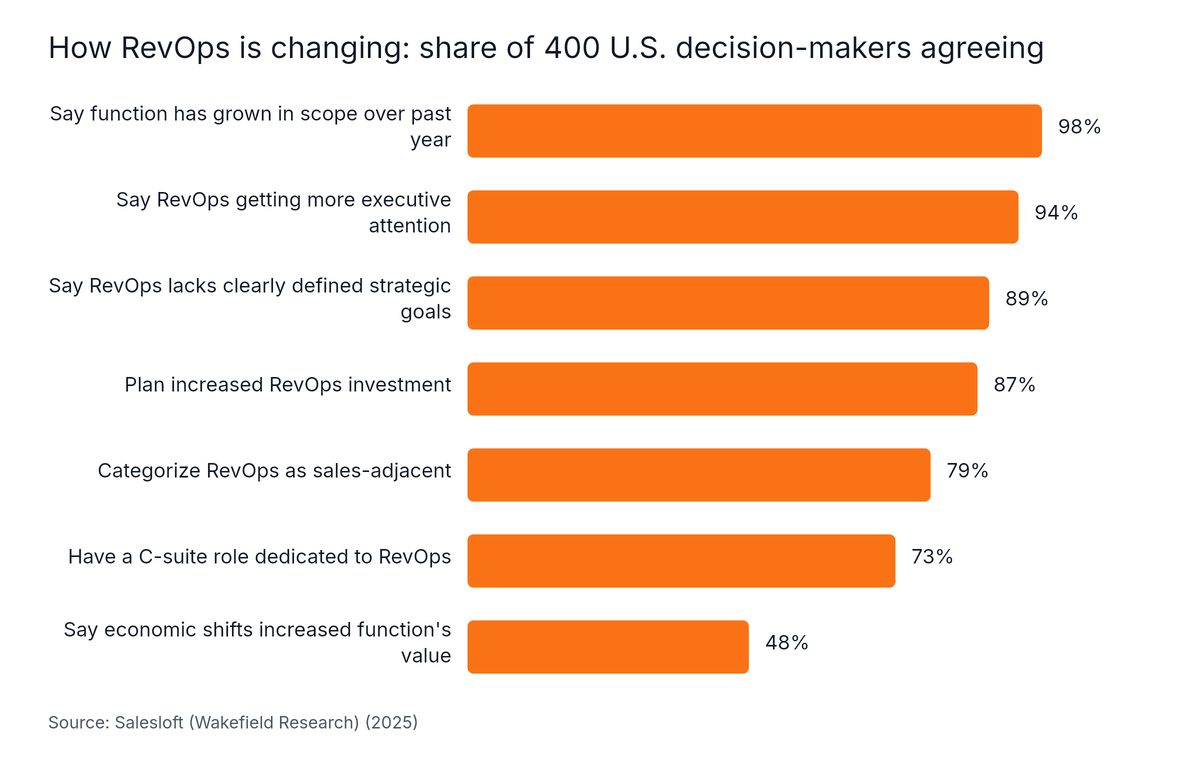
A first RevOps hire needs an outside peer group because the function has no settled scope inside most companies. In the 2025 Wakefield Research study for Salesloft, 89% of 400 U.S. decision-makers said RevOps lacks clearly defined strategic goals (Salesloft, 2025). Peers fill the gap that a missing internal team leaves.
A lone operations hire at a startup desk glancing toward an empty chair beside them
The same study shows a function that is growing quickly. It found that 73% of surveyed companies now have a C-suite role dedicated to RevOps (Salesloft, 2025). The study surveyed 400 U.S. RevOps and executive decision-makers and was commissioned by a vendor, so read it as a directional signal.
Horizontal Bar chart: How RevOps is changing: share of 400 U.S. decision-makers agreeing. Highest: Say function has grown in scope over past year at 98%.
The chart shows how widely respondents agreed. In that study, 98% said the function has grown in scope over the past year, and 94% said it is getting more executive attention (Salesloft, 2025). A role that changes this quickly is hard to track alone.
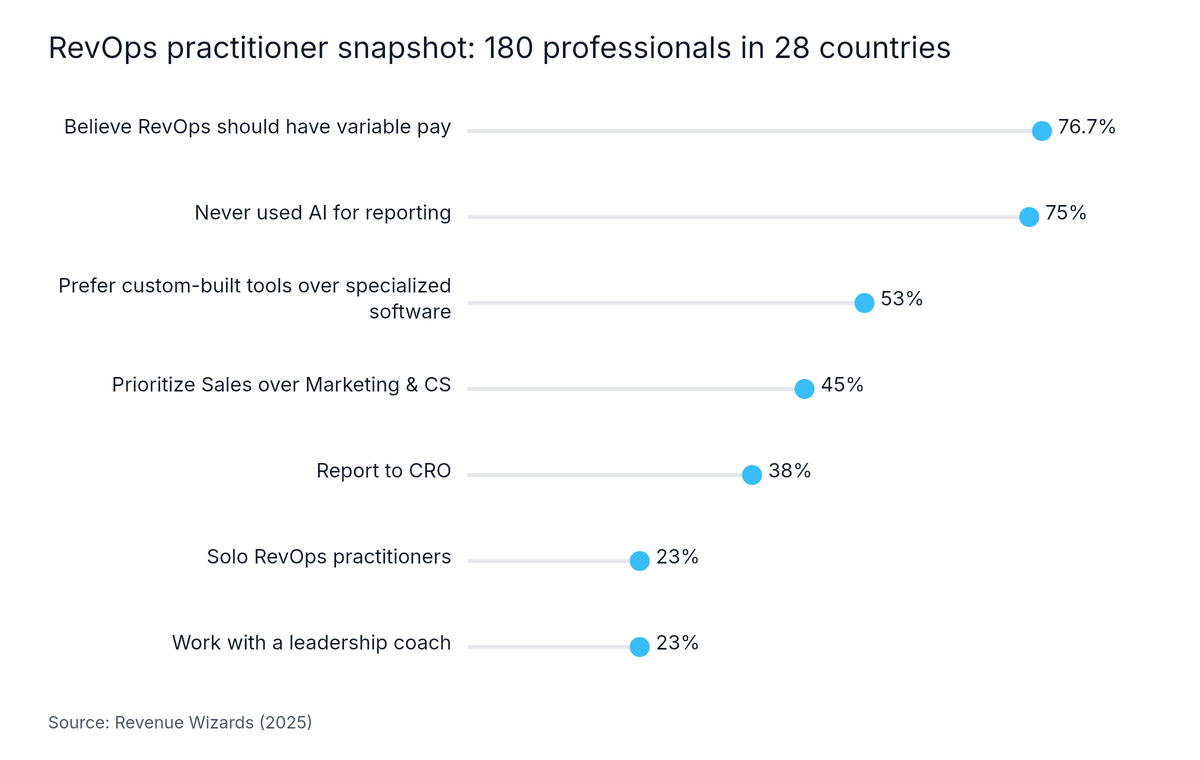
The no-peer problem is common. A solo RevOps practitioner is the only person doing the function at a company. In the Revenue Wizards survey of 180 RevOps professionals across 28 countries, 23% were solo, some inside firms with 1,000+ employees (Revenue Wizards, 2025). A vendor ran that survey, and its sample is self-selected.
Peer benchmarks also matter for role design. A November 2024 survey from BoostUp.ai and RevOps Co-op, based on more than 1,200 revenue professionals, found only 23% of respondents could prioritize go-to-market strategy, even though 48% ranked it the top driver of revenue success (SalesTechStar, 2024).
How do you keep up with CRM and marketing-automation release notes without overload?
Keeping up with CRM and marketing-automation release notes without overload means subscribing to one or two vendor feeds for the systems the company actually runs, and reading them on a fixed day. Gartner predicts that by 2027, 95% of sellers' research workflows will begin with AI (Gartner, 2026), so release volume will keep rising.
Release notes are a vendor's dated list of shipped changes, and a changelog is the developer-facing version. Skip feeds for tools the company does not own. Customer relationship management (CRM) release notes matter most, because platform changes are the part of revenue operations news that most often breaks something.
Google, for example, moved custom offline conversion uploads to the Data Manager API from June 15, 2026. A team that sends qualified stages back to an ad platform needed to know that date. A 2026 study of 104 Google Ads accounts (GrowthSpree, 2026) found that 91% had no Google click ID (GCLID) reaching the CRM, so many teams had little to send back in the first place.
Which platform update channels to watch
Pick from this list based on the stack:
CRM release notes. The dated notes for the CRM the company runs, whether HubSpot or Salesforce.
Marketing-automation and ad-platform changelogs. Any system that receives or sends conversion data.
Admin and developer communities. The vendor's own admin forum or developer changelog, for details the notes leave out.
Integration and sync notes. Updates to connectors between the CRM and other tools, which often change field behavior.
No single vendor feed is a neutral source of news. Each tells you what the vendor shipped, not what it means for your stage definitions or reports. For the wider stack question, see the guide to revenue operations software.
A RevOps analyst scanning a short list of product update notes on a laptop with a notebook open
What should a RevOps hire filter when following AI and platform news?
A RevOps hire should filter AI and platform news by one test: does the announcement change who owns a data fact, a stage definition or a report? In a 2025 survey of 180 RevOps professionals, 75% had never used AI for reporting (Revenue Wizards, 2025), so most teams are still evaluating, not adopting.
Keep that context in mind when headlines suggest everyone has moved on.
Lollipop chart: RevOps practitioner snapshot: 180 professionals in 28 countries. Highest: Believe RevOps should have variable pay at 76.7%.
Data quality is the recurring topic. In the 2025 State of RevOps Survey, 99% of respondents admitted struggling with technical data challenges (RevOps Co-op, 2025). Openprise, which ran the survey, reports that only 11% of RevOps teams rate their data quality as excellent (Openprise, 2025). Neither page states a sample size, and both come from a vendor, so treat the figures as a published signal.
Revenue Wizards makes the practical point in its October 2026 post: "for most teams the first AI project is still a data project" (Revenue Wizards, 2026).
Three questions to ask of any announcement
Which system would own the data if an agent or new feature touched it?
Does it alter how a source is credited, as in the attribution model in use?
A Gartner survey of 227 chief sales officers published in May 2026 linked AI-enabled next best actions to 2.6x higher likelihood of commercial growth (Gartner, 2026). Treat a result like this as a prompt to check your own data first, not as a reason to buy.
What does a weekly news routine look like for a solo RevOps hire?
A weekly news routine for a solo RevOps hire fits in 30 minutes: one community, two newsletters, one or two vendor release-note feeds, and one written note on what to act on. In a 2025 Revenue Wizards survey, 23% of 180 RevOps professionals worked solo (Revenue Wizards, 2025).
A first RevOps hire with a small timer and notebook blocking thirty minutes for reading
The weekly RevOps news routine caps inputs because the number of sources matters less than reading them on a fixed day and recording one decision. It assumes no team to split the reading.
Choose one community. Join one practitioner community from the table above and read its recent threads (10 minutes).
Pick two newsletters. One independent practitioner newsletter and one digest that summarizes news (10 minutes).
Scan one or two release-note feeds. Only for systems the company runs (5 minutes).
Write one line. Note a change, who owns the data it touches, and whether it needs action (3 minutes).
Review monthly. Drop any source that produced no action in four weeks, and add one question to the community (2 minutes).
The routine is a starting point, not a standard. Adjust the block length to the size of the stack, and keep the cap on sources.
Who is a revenue operations news routine not for?
A revenue operations news routine is not for teams that already have a large internal RevOps group, or for readers who want a ranked list of the best sources. It names communities and source types without endorsing any single vendor feed, and every membership figure in the research is self-reported or unverified.
Four limits apply:
No member counts. Sizes conflict across sources and are self-reported, so none are published here.
Vendor-run research. The Wakefield study of 400 U.S. decision-makers was commissioned by Salesloft (Salesloft, 2025), and a vendor ran the Revenue Wizards survey of 180 professionals (Revenue Wizards, 2025). Samples are self-selected or unstated in places.
U.S.-weighted evidence. The Wakefield sample is U.S. decision-makers only. Readers elsewhere should check chapter locations and time zones.
Costs change. Confirm tiers and pricing on each community's own page.
Frequently Asked Questions
Is RevOps Co-op free to join?
RevOps Co-op has a free Starter tier that includes community access and events. Its paid Rise tier costs $63 a month billed annually, as listed on its membership page in November 2026. Pricing and tier contents can change, so check the membership page before deciding.
Where do RevOps professionals get their news and updates?
RevOps professionals get news from four places: peer communities such as RevOps Co-op, RevGenius, Wizards of Ops and Pavilion; independent newsletters and podcasts; analyst and survey research; and vendor release notes for the systems they run. Most keep the list short and read it on a fixed schedule.
Are there good RevOps subreddits?
Subreddits such as r/RevOps, r/salesforce and r/hubspot are used for quick admin and configuration questions. Answers are unverified and quality varies by thread, so treat them as leads to check against vendor documentation. Subscriber counts are not listed here because they could not be verified.
Are there RevOps communities in the UK, Europe or India?
RevOps Co-op reports a global membership and runs local chapters, and Pavilion cites 50+ local chapters. Chapter locations and event times vary, so check each community's own chapter list for the nearest city and a workable time zone before joining.
How can a solo RevOps person at a startup find peers?
A solo RevOps person can find peers by joining one practitioner community, asking one specific question in it each month, and attending a local chapter event where one exists. In a survey of 180 RevOps professionals by Revenue Wizards, 2025, 23% worked solo, so peers in the same position are easy to find.
Conclusion
Revenue operations news for a B2B SaaS team is not a hunt for one perfect source. It is a short list, read on a schedule, with a decision at the end.
Use four source types: communities, independent publications, research with stated method, and release notes.
Join one community first, and check cost and access on its own page.
Cap inputs at one community, two newsletters and one or two feeds.
Filter every AI or platform announcement by who owns the data it touches.
Drop any source that has not produced an action in a month.
For the stack questions that come next, read the guide to revenue operations software. One funnel. One set of definitions. One number everyone trusts. To talk through your funnel, CRM or reporting question, Meet with an expert for a free consultation.
Written by
Ishan Manchanda
Ishan Manchanda is co-founder of GrowthSpree, a B2B SaaS marketing consultancy founded in 2017 that has managed $60M+ in ad spend across 300+ B2B SaaS companies. He focuses on demand generation, go-to-market strategy and pipeline growth, and has been featured in Silicon Valley Times, SaaS Mag and the Unbounce podcast.
 Ishan ManchandaNov 25, 2026