Revenue Operations Solutions Provider: What to Look for Before You Sign
revenue operations solutions providerrevenue operations service providersrevenue operations as a service
Revenue Operations Solutions Provider: What to Look for Before You Sign
Embedded, project-based or RevOps as a service? Compare the three models, their price ranges and deliverables, plus the questions to ask before you sign.
Request a quote and our experts will contact you within 24 hours with tailored solutions and pricing.
Revenue Operations Solutions Provider: What to Look for Before You Sign
By the RevOps for B2B SaaS Editorial Team. Last updated November 4, 2026.
A revenue operations (RevOps) solutions provider is an outside firm or operator that builds and runs a B2B SaaS team's customer relationship management (CRM) system, attribution, and reporting under one of three models. Most vendor decks make those models look the same.
Choosing a revenue operations solutions provider matters early. SyncGTM reports that 78% of B2B companies with 50+ employees now have a dedicated RevOps function (SyncGTM, 2026), yet at Seed to Series A the benchmark team is a single person. That gap is why a Series A CRM rebuild often goes to outside help first. This guide defines each model, maps what it delivers, and lists the questions to ask. For the in-house alternative, see consultant versus internal hire.
Key Takeaways
A revenue operations solutions provider sells one of three models: embedded service, project-based consulting, or RevOps as a service.
Each model should name its CRM build, attribution setup, and reporting layer deliverables, plus who owns them after the engagement ends.
Published pricing for outsourced RevOps is vendor self-reported, with no stated sample, and varies widely by source.
The best pre-signing questions cover ownership, staffing, scope changes, exit terms, and data readiness.
What should you look for in a revenue operations solutions provider?
A revenue operations solutions provider for a Series A CRM rebuild should name three deliverables in writing: the CRM build, the attribution setup, and the reporting layer. It should also state who owns admin access and documentation at exit. Data quality is the usual failure point: 38% of revenue operations leaders say inaccurate data is among users' top challenges (Forrester, 2025).
Three evaluation checklists on a table beside a laptop showing a CRM pipeline view
When screening a revenue operations solutions provider, use these five criteria:
Named deliverables. The proposal lists the CRM objects, stage definitions, and dashboards it will produce, not just "strategy" or "optimization."
Ownership at exit. Your company holds admin credentials, documentation, and the reporting files from day one.
Stage fit. The provider has worked with teams of your size and can say what to defer. For a pre-Series A team, that usually means getting stage definitions and the CRM right before building multi-touch attribution.
Staffing clarity. The contract states who works on your account and whether junior staff can change your objects without senior review.
A clear exit condition. The agreement says what "done" looks like and what happens in month seven.
Stage definitions come first because every later report depends on them. A rebuild without written entry criteria for each lifecycle stage repeats the same disputes in new software.
What are the three types of revenue operations service providers?
Revenue operations service providers sell three distinct models. An embedded service places an operator inside the team on a monthly basis, project-based consulting delivers a fixed scope for a one-time fee, and RevOps as a service is a retainer for a managed, ongoing team. Vendors use the labels loosely, so the contract matters more than the deck.
Three distinct wooden blocks side by side representing three service models
Embedded service is a RevOps operator who works inside your systems and your meetings for a monthly fee, often described as fractional.
Project-based consulting is a fixed-scope engagement, such as a CRM rebuild, delivered for a one-time fee and then handed over.
RevOps as a service is a managed retainer in which a provider runs ongoing RevOps work with a team, not one person.
Model
Who does the work
Billing basis
Typical exit condition
Embedded service
One operator inside your team
Monthly fee
Notice period, or a first in-house hire takes over
Project-based consulting
A consultant or small team
Fixed scope and fee
Handover of the finished build and documentation
RevOps as a service
A provider team
Monthly retainer
Contract term and notice period
What each model delivers
The same three deliverables should appear in every proposal. What differs is who owns them afterward.
Deliverable
Embedded service
Project-based consulting
RevOps as a service
CRM build
Built and maintained by the operator
Built once to a written spec
Built and changed through a request queue
Attribution setup
Configured and checked over time
Configured once, handed over
Configured and monitored by the provider
Reporting layer
Evolves with your questions
Fixed set of dashboards at handover
Standard reports plus requests
Owned after the engagement
Depends on documentation kept
Should be you, per the handover
Often the provider unless the contract says otherwise
Attribution setup needs the most care. Forrester reports that the average B2B purchase now involves 22 stakeholders, 13 internal and nine external (Forrester, 2025), so setup has to cover buying groups, not single leads. The Google click ID (GCLID) is the parameter that links an ad click to a lead record, so qualified stages can be sent back to the ad platform. Without it, spend cannot be tied to revenue.
Audit data: An audit of 104 Google Ads accounts found 91% had no GCLID reaching the CRM (GrowthSpree, 2026). After a 90-day attribution fix, the share of closed-won deals traced to a campaign rose from 0% to 67% (GrowthSpree, 2026).
What do revenue operations service providers deliver versus an internal hire?
Revenue operations service providers deliver defined builds, such as a CRM configuration, attribution setup and reporting layer, for a monthly or project fee, while an internal hire delivers continuous ownership. SyncGTM's 2026 survey of 1,200+ B2B companies puts the typical Seed to Series A RevOps team at one person, usually a generalist (SyncGTM, 2026).
A hiring folder and a project handover binder placed next to each other on a desk
A provider brings a finished structure quickly. An internal hire brings context, daily availability, and accountability for the numbers. Neither option excludes the other. Several practitioner buying guides now describe a sequence: a provider does the front-loaded build, then a first in-house operator runs a documented system. That is practitioner opinion from vendor posts, not research.
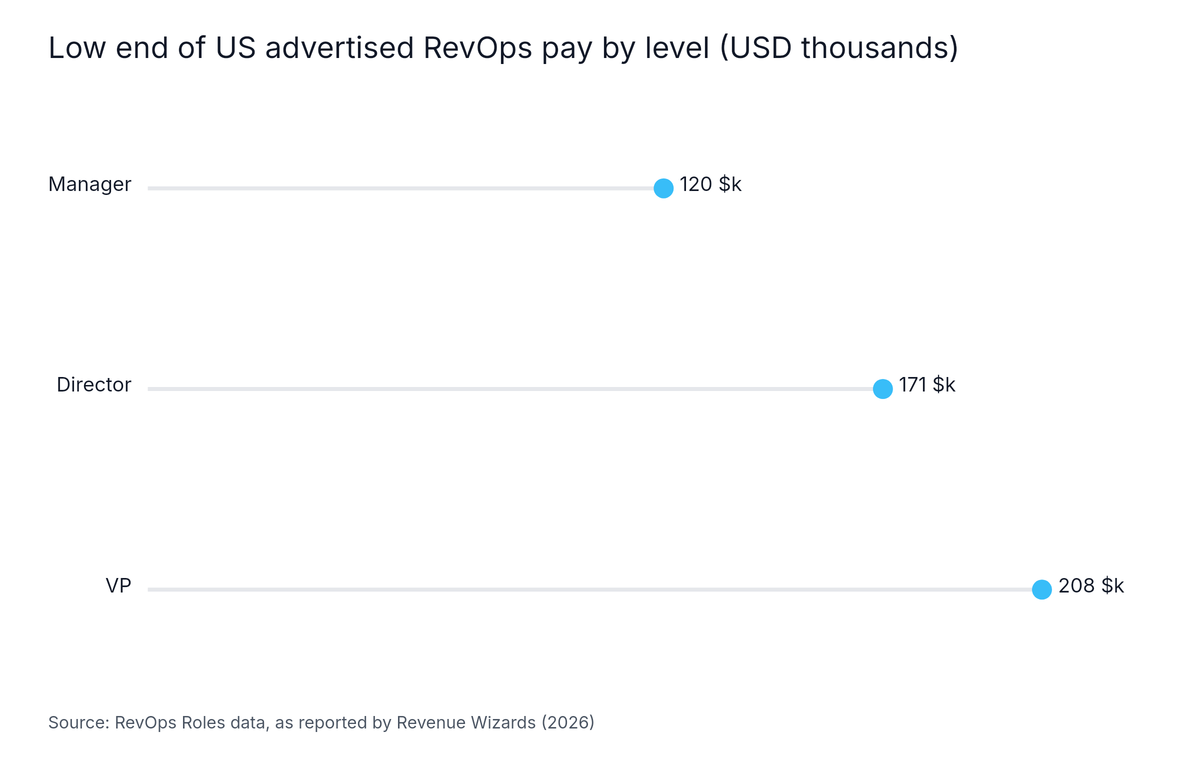
The cost of the internal alternative is easier to see because it comes from posted salaries. An analysis of 8,278 US job postings that disclosed pay, reported by Revenue Wizards in October 2026, shows advertised pay of $120k to $170k for a RevOps Manager, $171k to $239k for a Director, and $208k to $275k for a VP. The chart below plots only the low end of each band.
Lollipop chart: Low end of US advertised RevOps pay by level (USD thousands). Highest: VP at 208 $k.
How much does revenue operations as a service cost?
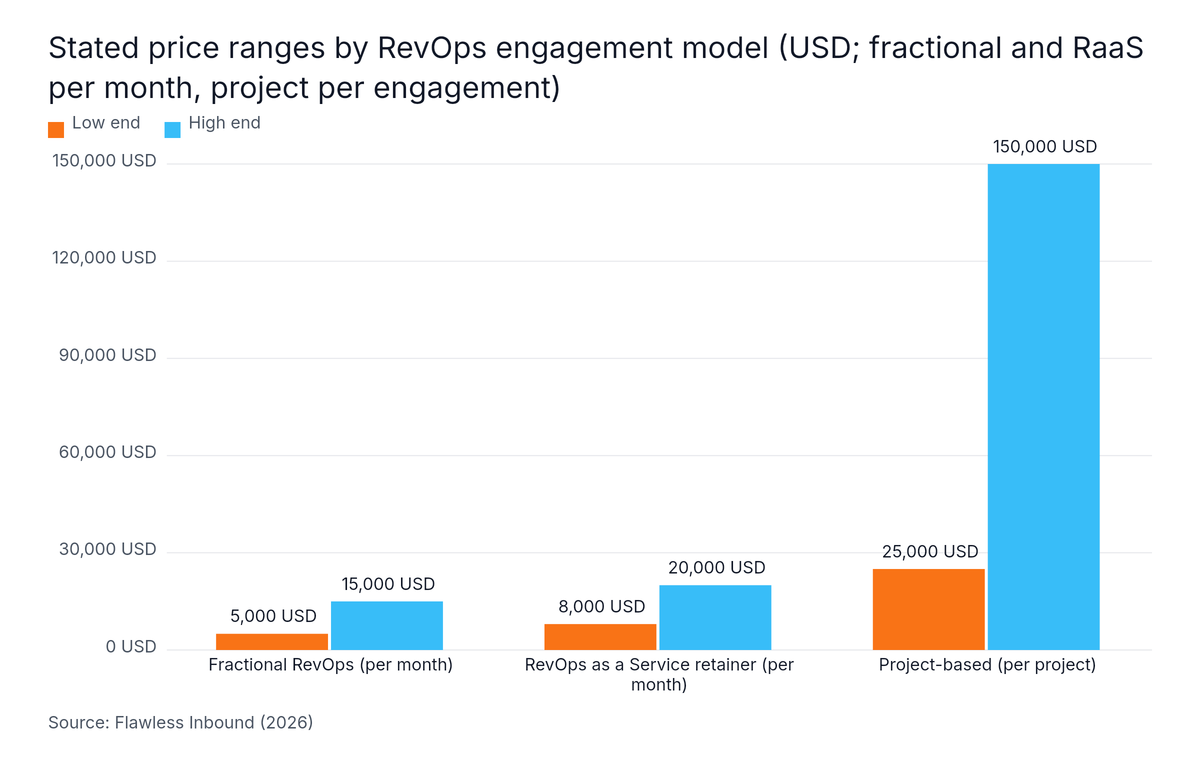
Revenue operations as a service retainers are priced at $8,000 to $20,000 per month in one vendor guide (Flawless Inbound, 2026), against $5,000 to $15,000 per month for fractional help and $25,000 to $150,000+ for a project. All published ranges are vendor self-reported with no stated sample, so treat them as indicative.
Three stacks of coins of different heights beside a calendar page
Four vendor guides give four different pictures. The spread is itself a finding: quotes vary widely, and labels like "fractional" mean different things.
Grouped Bar chart: Stated price ranges by RevOps engagement model (USD; fractional and RaaS per month, project per engagement). Highest: Project-based (per project) at 25,000 USD.
The chart shows only the low end of each Flawless Inbound range: $5,000 per month for fractional, $8,000 per month for RevOps as a service, and $25,000 per project. Monthly and per-project figures use different units, so use the table for full ranges. To compare quotes fairly, normalize them by hours, seniority, and named deliverables rather than headline price.
Ready to pressure-test a proposal? Bring a quote or a scoping question to a free consultation with a RevOps expert. Meet with an expert
Where can I hire a revenue operations service for an early-stage SaaS company?
An early-stage SaaS company can hire a revenue operations service through four channels: referrals from investors and peer founders, RevOps practitioner communities, CRM vendor partner directories, and fractional marketplaces. No independent study ranks these channels, so screen each as a lead, not an endorsement. SyncGTM's 2026 survey puts the typical Seed to Series A team at one person.
Because the benchmark team is that small, a single provider contact often becomes the whole function (SyncGTM, 2026). Screening matters more than the channel. Run every candidate through the same four steps:
Ask for a written scope that names the CRM build, attribution setup, and reporting layer.
Ask for price and phase length in writing, since few firms publish either.
Ask to speak with a client at your stage, such as a team with a handful of reps and one CRM.
Check that your team can hold admin credentials throughout.
Platform-certified partners can be a useful filter for a specific CRM, but a certification shows platform knowledge, not fit for your funnel. Compare candidates on your own criteria, not on a ranking. For stack context, see revenue operations software and what the stack covers.
What should you ask a revenue operations provider before signing?
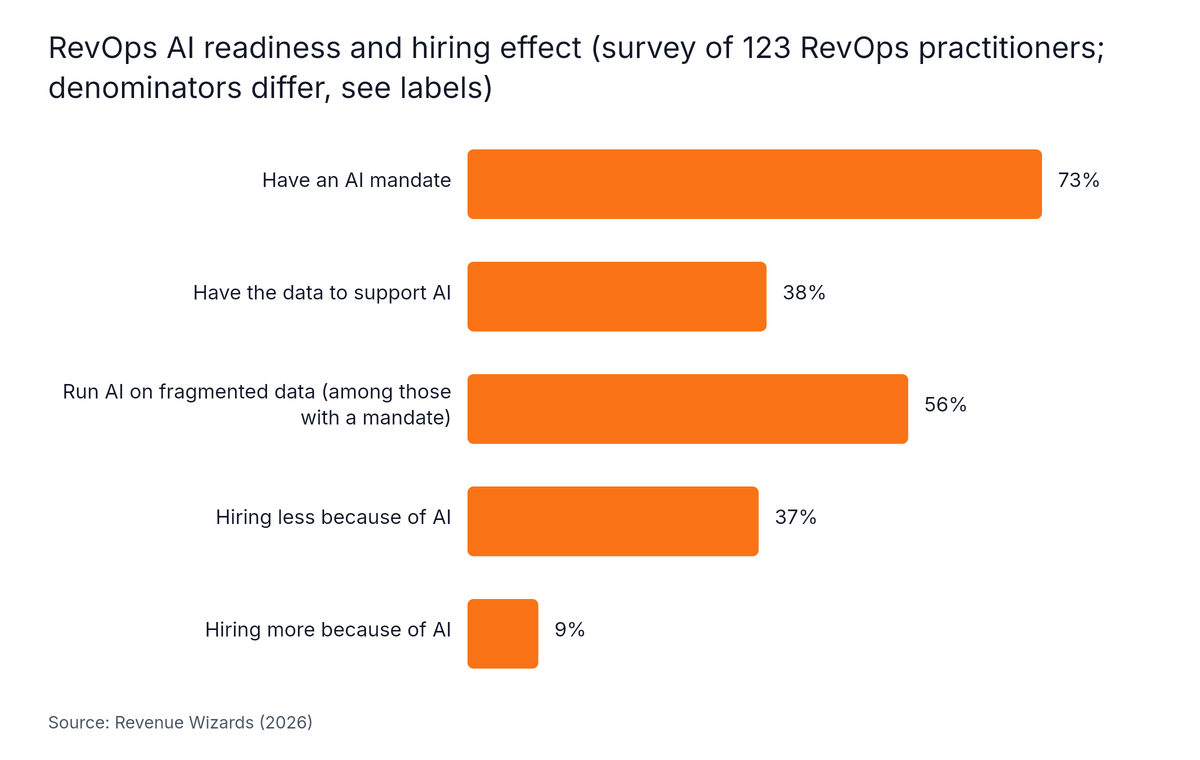
Before signing with a revenue operations provider, ask about ownership, staffing, scope, exit and data readiness, and get each answer in the contract. Data readiness is the newest gap: 73% of RevOps teams have an AI mandate, but only 38% have the data to support it (Revenue Wizards, 2026).
A contract with a pen and a list of numbered questions on a meeting table
The survey covered 123 RevOps practitioners in May 2026 and states: "73% have an AI mandate, but only 38% have the data to support it." (Revenue Wizards, 2026). The same survey found 37% of RevOps teams hiring less because of AI, versus 9% hiring more. It is vendor research with a small sample, so read it as directional. Forrester's view of the cause is plain: "Organizations require data of quality, texture, and substance suitable to the task." (Forrester, 2025)
Horizontal Bar chart: RevOps AI readiness and hiring effect (survey of 123 RevOps practitioners; denominators differ, see labels). Highest: Have an AI mandate at 73%.
When screening a revenue operations solutions provider, put these seven questions to every candidate:
Who holds admin credentials, and when do we receive documentation?
Is documentation a named deliverable with a due date?
Who staffs the account, and can junior staff change our objects without senior review?
What does a scope change cost, and who approves it?
What is the minimum term and notice period?
Do we own the CRM configuration, dashboards, and workflows at exit?
How does the CRM build prepare our data for AI use?
Questions by model
Model
Ask this
Embedded service
What happens if the operator leaves, and who covers the gap?
Project-based consulting
What does "done" look like, and what is the support window after handover?
RevOps as a service
What happens in month seven, once the build is done and the retainer continues?
Forrester's Revenue Operations Survey from 2024 shows why process design belongs in the scope: 49% of leaders say processes are not flexible enough to respond quickly to change, and 46% say processes are mostly manual (Forrester, 2025). Validity's survey of 602 CRM users found 37% report losing revenue because of poor CRM data quality (Validity, 2025). A good provider scopes data cleanup before building dashboards on top of it. Dashboard scope is covered in what a RevOps reporting dashboard should show.
Who is outside RevOps help not for?
Outside RevOps help is not for companies with no sales team and no CRM yet, nor for buyers who want a provider ranking. The published evidence is also thin: pricing comes from vendor guides with no stated sample, and 49% of revenue operations leaders say their processes are not flexible enough (Forrester, 2025).
No sales team or CRM yet. There is nothing to rebuild. Start with stage definitions and a simple CRM setup.
Buyers who want a ranked list. This guide does not recommend or rank providers. It gives criteria so the choice rests on your needs.
Anyone expecting precise benchmarks. No tier 1 research compares outsourced and in-house RevOps outcomes, and claims that agencies are cheaper than hires are vendor assertions. Pay data for the in-house option is US-centric, and UK, European, or Indian pricing is not covered here.
Teams treating AI as a shortcut. A provider cannot fix data that was never defined.
Frequently Asked Questions
What do revenue operations service providers deliver versus an internal hire?
Revenue operations service providers deliver defined builds, usually a CRM configuration, attribution setup and reporting layer, for a project fee or monthly retainer. An internal hire delivers continuous ownership and context. At Seed to Series A, SyncGTM's 2026 survey puts the typical RevOps team at one person, so many teams buy the build first and hire later.
Where can I hire a revenue operations service for an early-stage SaaS company?
An early-stage SaaS company can hire a revenue operations service through referrals from investors and peers, RevOps practitioner communities, CRM vendor partner directories and fractional marketplaces. No independent study ranks these channels, so screen every lead the same way: ask for scope, price, phase length, staffing and handover terms in writing.
What is the difference between embedded service, project-based consulting and RevOps as a service?
An embedded service places an operator inside the team on a monthly fee. Project-based consulting delivers a fixed scope for a one-time fee. RevOps as a service is a managed retainer for ongoing work. Vendors blur these labels, so compare who does the work, how billing works and what happens at exit.
When should a B2B SaaS company hire its first in-house RevOps person?
Most B2B SaaS companies hire their first RevOps person around Series A, when marketing and sales report different numbers for the same pipeline or a CRM rebuild is due. Common triggers are a missed forecast, a funding round, or the point where spreadsheets can no longer track the funnel.
Conclusion
Picking a revenue operations solutions provider is a contract decision first and a vendor decision second. Keep these points in front of you:
Three models exist: embedded service, project-based consulting, and RevOps as a service.
Every proposal should name the CRM build, attribution setup, and reporting layer, plus who owns each afterward.
Published prices are vendor self-reported, so normalize quotes by hours, seniority, and deliverables.
Screen hiring channels with the same written questions, whatever the source.
Ask how the build prepares your data before any AI work starts.
Your next step is to put the seven shared questions in front of every candidate and compare the written answers side by side. Then read when a first in-house operator should take over to plan the handover.
Written by
Ishan Manchanda
Ishan Manchanda is co-founder of GrowthSpree, a B2B SaaS marketing consultancy founded in 2017 that has managed $60M+ in ad spend across 300+ B2B SaaS companies. He focuses on demand generation, go-to-market strategy and pipeline growth, and has been featured in Silicon Valley Times, SaaS Mag and the Unbounce podcast.
 Ishan ManchandaNov 10, 2026